

Ghana to Revive Cotton Production with Modern Biotech
June 15, 2012| |
Ghana government recognizes the potential of modern biotechnology in reviving the cotton sector. The Minister for Environment, Science and Technology, Hon.Mrs Sherry Ayittey, said this while opening a two-day workshop in the capital city Accra on June 11, 2012. The workshop, which was organized by the Ministries of Trade and Industry, Food and Agriculture, and Environment, Science and Technology in collaboration with UNIDO aimed to sensitize stakeholders on opportunities available to boost cotton productivity in Northern Ghana. Noting that Ghana's cotton production had dropped drastically after the 1990s from 45,000 tonnes to 20,000 tonnes per year, the Minister said modern biotechnology holds the key to solving this problem. A number of effective interventions have emerged to boost the cotton industry globally, including from neighboring Burkina Faso.
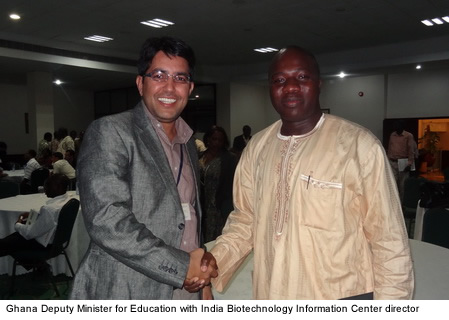
Confirming the benefits of Bt cotton, Mr. KarimTraore, President of National Union of Cotton producers of Burkina Faso, said farmers are the biggest beneficiaries as they have been saved from exposure to harmful pesticides from eight to two applications, and from time spent in farm spraying. "These hazards have greatly been reduced and we use the extra time to grow more food crops," he said. The same sentiments were echoed by a South African farmer Frans Malela present and corroborated by Bhagirath Choudhary who shared India's 10-year experience with Bt cotton.
Mr Frank Van Rompaey, UNIDO Country Representative, said the partnership was aimed at supporting the government in improving competitiveness of cotton and exploring the various options available. Key recommendations included the need to fasttrack development of a legal instrument for biosafety compliance; development of a communications strategy to systematically engage the public; explore possible suppliers of the Bt technology - their advantages/strengths; create and strengthen an independent farmers/growers association and establish a national standard based on international standards to ensure high quality Bt cotton seed and lint once introduced.
Approximately 160 million hectares of biotech cotton have been successfully planted since 1996, when first cultivated. Insect resistant cotton, featuring Bt genes, and herbicide tolerant cotton were amongst the first products to be commercialized. Their impact has been substantial in all 13 countries growing biotech cotton, which was ~25 million hectares in 2011. India with 10.6 million hectares, USA 4.0 million, China 3.9 million, and Pakistan 2.6 million hectares are the world leaders.
For more on this workshop contact Dr.Mpoko Bokanga, Unit Chief, Agribusiness Development Unit, UNIDO at m.bokanga@unido.com.
| |
Biotech Updates is a weekly newsletter of ISAAA, a not-for-profit organization. It is distributed for free to over 22,000 subscribers worldwide to inform them about the key developments in biosciences, especially in biotechnology. Your support will help us in our mission to feed the world with knowledge. You can help by donating as little as $10.
-
See more articles:
-
News from Around the World
- Dr. Daniel Hillel Named 2012 World Food Prize Laureate
- World Food Stocks Rise but Hunger Threatens Arab Countries
- SAVE Food Initiative to Reduce Wastage and Loss
- Global Seeds Market Report 2012
- Togo's Ministry of Agriculture Foresees Great Potential in Agricultural Biotechnology
- Ghana to Revive Cotton Production with Modern Biotech
- Vita Launches Potato Centre of Excellence in Africa
- GM Soybean Approved for Commercial Use in Mexico
- Current Challenges and New Tools to Combat Herbicide Resistant Weeds
- Overcoming Build-up of Insect Resistance Against Bt
- SIUE Makes Biofuel Breakthrough
- BASF Presents Innovations in the Pipeline
- SG Biofuels New Genomics Research Center to Support Commercial Advancements
- Next-generation Sequencing Technology Opens Doors to Discoveries
- GM Crops Shrink Farming's Pesticide Footprint
- Pakistan Minister Sees Need to Redefine Parameters of Agric Production
- Defense Mechanism of Lectin in Plant Uncovered
- Implications of GM Seeds on Chinese Farmers' Rights to Food
- Program on Development of Biotechnology in Russia Through 2020
- Rothamsted and BBSRC Launch "20:20 Wheat"
- New Insights on How Plants Fight Diseases
-
Research Highlights
- Scientists Trace Footprints of Photoperiod Pathway Genes in Oryza
- Introgression of Brassica rapa subsp. sylvestris Blackleg Resistance into B. napus
- Comparison on Mutagenic Effects of Commercial Soybeans in Brazil
-
Beyond Crop Biotech
- University of California Researchers Create Mosquitoes that Cannot Transmit Malaria
- GE Diamondback Moth to Decrease the Pest's Population
- Scientists Use Nanomedicine to Combat Herpes
-
Announcements
- Raman Fellowships for African Researchers in India
- 2012 Global Farmer's Roundtable Online Nominations Open
-
Read the latest: - Biotech Updates (May 2, 2024)
- Gene Editing Supplement (April 24, 2024)
- Gene Drive Supplement (February 22, 2023)
-
Subscribe to BU: - Share
- Tweet