

UN Releases Global Report on the State of Food Security and Nutrition
July 22, 2026| |
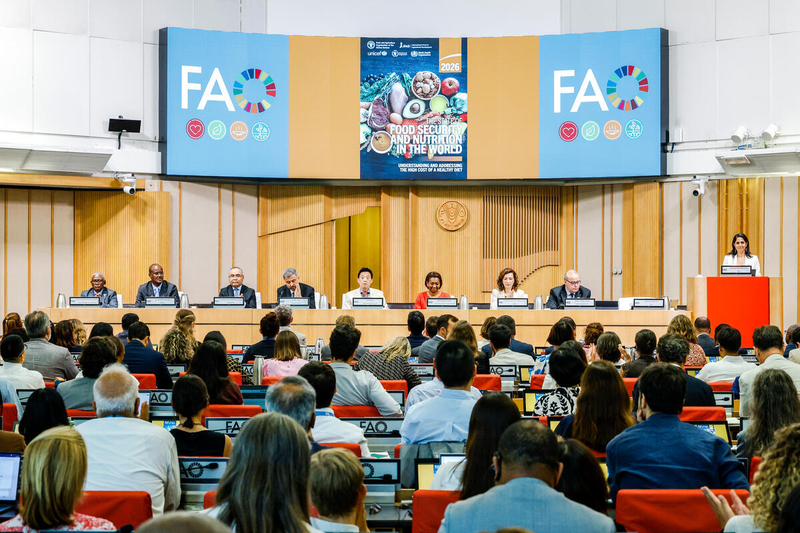
The number of hungry individuals continues to decrease for the third year in a row, showing progress is attainable. However, the progress recorded was unstable, unevenly distributed, and insufficient to attain the Sustainable Development Goals by 2030. These are the highlights of the Food and Agriculture Organization of the United Nations (FAO) report on The State of Food Security and Nutrition in the World 2026 (SOFI 2026) released on Tuesday, July 21, 2026 at FAO Headquarters in Rome, Italy.
The report also presented the following key findings:
- 7.8 percent of the global population faced hunger in 2025, down from 8.1 percent in 2024 and 8.6 percent in 2022, indicating slow progress
- around 645 million people were affected by hunger in 2025, representing a reduction of nearly 14 million compared to 2024 and 43 million compared to 2022
- 25.8 percent of the global population (around 2.1 billion people) experienced moderate or severe food insecurity, meaning they were at times forced to compromise on the quality or quantity of the food they ate
- More than half of Africa's population (56.6 percent) faced moderate or severe food insecurity in 2025, compared to 20.3 percent in Asia, 22.9 percent in Latin America and the Caribbean, and 8.7 percent in Northern America and Europe
- Africa is now home to approximately 309 million hungry people, making it the region with the highest number of hungry people
“The report shows that progress is possible, but we must move faster. Ending hunger and making healthy diets affordable requires political commitment, sustained investment and enabling policies. Recent crises – from natural disasters like the COVID-19 pandemic to man-made disaster like hotspots of conflicts, the war in Ukraine, the Gaza crisis, and the recent Strait of Hormuz disruption - have demonstrated both the resilience of agrifood systems and the need to strengthen them further to better serve the world's most vulnerable people, farmers and consumers,” said FAO Director-General, QU Dongyu.
Download SOFI2026 for more information.
| |
You might also like:
- Global Status of Commercialized Biotech/GM Crops: 2024
- Pocket K No. 30: Contributions of Agricultural Biotechnology in Alleviation of Poverty and Hunger
- Contributions of Biotech Crops to Food Security, Sustainability, and Climate Change Solutions
Biotech Updates is a weekly newsletter of ISAAA, a not-for-profit organization. It is distributed for free to over 22,000 subscribers worldwide to inform them about the key developments in biosciences, especially in biotechnology. Your support will help us in our mission to feed the world with knowledge. You can help by donating as little as $10.
-
See more articles:
-
Plant
- University of Missouri Develops Rapid Detection Test for Rocky Mountain Spotted Fever
- Genome Editing Turns Red Perilla Green while Boosting Health Benefits Sixfold
- Tiny Gene Edit Cuts Toxic Cadmium in Rice by Half
-
Animal
- The Pirbright Institute Achieves World’s First Gene-Edited Biting Midges
-
Food
- South Korea Expands Mandatory Biotech Labeling Rules for Processed Foods
- UN Releases Global Report on the State of Food Security and Nutrition
- Researchers Urge Stronger Public Education to Improve GMO Acceptance in Malaysia
-
Environment
- Join ASCA2026 in Malaysia
-
Read the latest: - Biotech Updates (September 16, 2026)
- Gene Editing Supplement (August 26, 2026)
- Gene Drive Supplement (February 22, 2023)
-
Subscribe to BU: - Share
- Tweet