New Book about 20 Years of Experience with GM Crops |
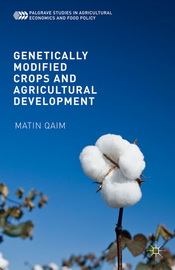 In spite of the rapid adoption of GM crops, their use remains contentious. Public opposition and overregulation have become real threats to further developments in modern plant sciences. It is widely believed that GM crops are bad for human health, damage the environment, and hurt smallholder farmers in developing countries, but research shows that the opposite is true. Matin Qaim, a professor of agricultural economics in Germany, has studied the impacts around the world. He has now written a book about his 20 years of experience. The book "Genetically Modified Crops and Agricultural Development" was recently published by Palgrave Macmillan. In spite of the rapid adoption of GM crops, their use remains contentious. Public opposition and overregulation have become real threats to further developments in modern plant sciences. It is widely believed that GM crops are bad for human health, damage the environment, and hurt smallholder farmers in developing countries, but research shows that the opposite is true. Matin Qaim, a professor of agricultural economics in Germany, has studied the impacts around the world. He has now written a book about his 20 years of experience. The book "Genetically Modified Crops and Agricultural Development" was recently published by Palgrave Macmillan.
|
|
|
|
|
EFSA: Glyphosate Unlikely to Cause Cancer |
 A peer review expert group composed of scientists from the European Food Safety Authority (EFSA) and representatives of risk assessment bodies in EU Member States have finalized the reassessment of glyphosate. The report concludes that glyphosate is unlikely to be genotoxic (damaging to DNA), or to pose a carcinogenic hazard to humans, and proposes a new safety measure that will tighten the control of glyphosate residues in food. A peer review expert group composed of scientists from the European Food Safety Authority (EFSA) and representatives of risk assessment bodies in EU Member States have finalized the reassessment of glyphosate. The report concludes that glyphosate is unlikely to be genotoxic (damaging to DNA), or to pose a carcinogenic hazard to humans, and proposes a new safety measure that will tighten the control of glyphosate residues in food.
|
|
|
|
|
Magic Wheat Resistance Gene Sequenced |
 A team of scientists from the International Maize and Wheat Improvement Center (CIMMYT) in Mexico, together with partners in China, Norway, and Australia have sequenced and described a gene that can help wheat to resist four serious fungal diseases. The research team isolated the wheat gene Lr67, revealing how it hampers the growth of fungal pathogen through a novel mechanism. A team of scientists from the International Maize and Wheat Improvement Center (CIMMYT) in Mexico, together with partners in China, Norway, and Australia have sequenced and described a gene that can help wheat to resist four serious fungal diseases. The research team isolated the wheat gene Lr67, revealing how it hampers the growth of fungal pathogen through a novel mechanism.
|
|
|
|
|
|
|
|
|

|
A biweekly update on gene editing research, regulations, and impact
produced by ISAAA Inc. |
| |
|
|

|
| A monthly update on gene drive research and development provided by ISAAA in collaboration with the Outreach Network for Gene Drive Research |
| |
|
|
|
|
|
|