

Floral Dip-Based Gene Editing Boosts Indica Rice Resistance to Tungro
December 17, 2025| |
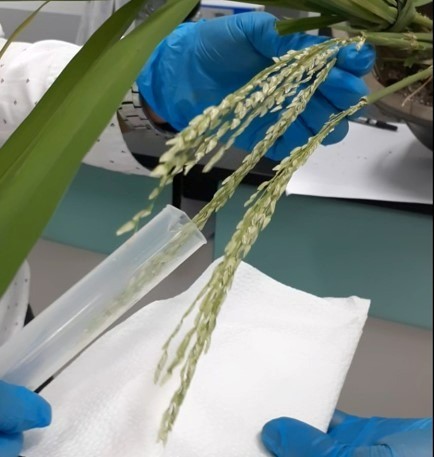
In a significant breakthrough for rice farmers, researchers from the Department of Agriculture–Crop Biotechnology Center (DA-CBC) have successfully used a novel floral dip-based gene editing technique to boost resistance to the devastating tungro virus in NSIC Rc 402, a widely grown Indica rice variety. Tungro, a viral disease transmitted by leafhoppers, poses a persistent threat to food security, resulting in annual crop losses that can reach up to 30%—equivalent to approximately 456,000 tons of rough rice. The new method offers a simpler, faster, and more practical solution compared to traditional tissue culture methods, which are often inefficient for Indica rice strains.
The innovative approach involves dipping rice flowers at the pre-anthesis stage into a solution containing Agrobacterium tumefaciens. This bacterium carries a CRISPR-Cas9 construct, a precise gene-editing tool designed to disable the plant's eIF4g gene, which is known to make the rice susceptible to the virus. From the harvested seeds of the treated plants, over 400 grew into healthy plants that survived antibiotic screening. Most importantly, seven of these lines maintained stable tungro resistance across three successive generations, demonstrating strong potential for reliable inheritance of the desirable trait.
According to project leader Dr. Reynante L. Ordonio, these findings confirm the floral dip method's ability to enhance disease resistance not just in NSIC Rc 402 but potentially in other vital Indica rice varieties. This development is expected to significantly accelerate rice breeding programs, allowing for the faster creation of improved lines with enhanced traits for yield, quality, and overall stress tolerance. The innovation marks a crucial step toward managing one of the country's most persistent rice diseases and offers renewed hope to farmers striving for sustainable agriculture and increased food production across the Philippines.
For more details, read the news release from PhilRice.
| |
You might also like:
- Novel CRISPR-Cas9 System Isolates Transgene-free Rice Crops
- Gene Enhances Rice Tolerance to Tungro Virus
- Tungro-Resistant Rice Developed through CRISPR-Cas9
Biotech Updates is a weekly newsletter of ISAAA, a not-for-profit organization. It is distributed for free to over 22,000 subscribers worldwide to inform them about the key developments in biosciences, especially in biotechnology. Your support will help us in our mission to feed the world with knowledge. You can help by donating as little as $10.
-
See more articles:
-
Gene Editing Supplement (December 17, 2025)
-
Research and Tools
- Rice Enzyme Helps Break Down Harmful Herbicide Residues
- CIMMYT Reports High-Efficiency Genome Editing in Pearl Millet
- Experts Use CRISPR-Cas12i3 to Improve Elite Corn Line
- Floral Dip-Based Gene Editing Boosts Indica Rice Resistance to Tungro
-
Read the latest: - Biotech Updates (October 7, 2026)
- Gene Editing Supplement (September 30, 2026)
- Gene Drive Supplement (February 22, 2023)
-
Subscribe to BU: - Share
- Tweet