

First Kapihan Session Convenes Lawmakers to Tackle Commercialization of Agri-Biotech Products in the Philippines
| |
The Philippines is recognized as Southeast Asia’s pioneer in agricultural biotechnology. It was the first in the region to establish a formal regulatory framework for genetically modified (GM) crops. The country reached a major milestone on December 4, 2002, when the Department of Agriculture - Bureau of Plant Industry (DA-BPI) approved the commercialization of Bt corn (MON 810), with the first successful planting following in 2003.
The 2002 approval marked a period of rapid scientific advancement in the country. Today, the adoption of biotech crops has slowed significantly due to the Writ of Kalikasan issued by the Court of Appeals in April 2024. The writ halted the commercial propagation of Golden Rice and Bt eggplant due to concerns about their environmental and health safety. This judicial intervention has created a "regulatory limbo" as crops already cleared by scientific agencies are blocked by the judiciary.
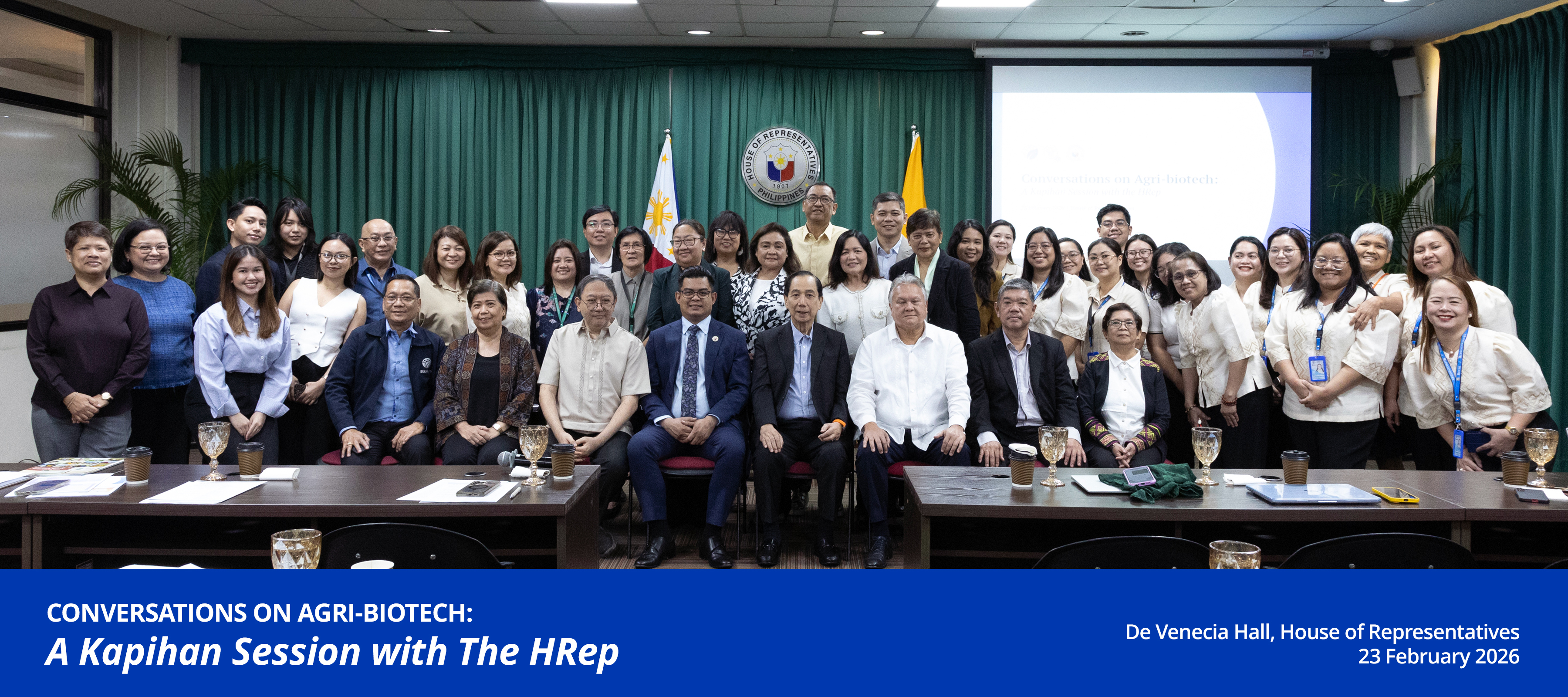
To help address these critical bottlenecks, ISAAA Inc., in collaboration with the Philippine Agriculture and Fisheries Biotechnology Program of the Department of Agriculture (DA Biotech Program), launched a series of Kapihan sessions for targeted stakeholder groups to improve their understanding of the benefits of biotechnology. The first session, titled Conversations on Agri-biotech: A Kapihan Session with the HRep, was sponsored by the House Special Committee on Food Security and gathered over 50 participants, including lawmakers, regulators, academics, scientists, researchers, and a farmer. The Kapihan Session at the HRep served as a platform for an open dialogue between policymakers and key stakeholders who discussed regulatory and commercialization barriers affecting the development and use of agri-biotech products in the country.
In his opening remarks, former Secretary of the Philippine Department of Agriculture and ISAAA, Inc. Board Chair Dr. William D. Dar emphasized that science and technology, when paired with sound policy, can transform lives. He cited the important role of agricultural biotechnology to the country, saying, “Agricultural biotechnology is a cornerstone of modern, resilient, and sustainable food systems.” He also highlighted the importance of aligning science with governance to ensure responsible development and use of technology.
Hon. Reymond Adrian E. Salceda (3rd District, Albay), Chairperson of the House Special Committee on Food Security, welcomed the participants to the Kapihan Session, stating: "Today's assembly symbolizes a shared dedication to confronting food security challenges head-on, with a specific emphasis on leveraging biotechnology to revolutionize our agricultural policies." He added that by fostering dialogue, promoting transparency, and ensuring rigorous regulatory standards, the country can harness biotechnology's full potential to address global challenges and improve the quality of life.
Economic Benefits vs. Regulatory Hurdles
Dr. Abraham J. Manalo, an Assistant Professor at the University of the Philippines (UP) Diliman and the Executive Secretary of the Biotechnology Coalition of the Philippines (BCP), presented on the agri-biotechnology landscape and the adoption of biotech crops in the Philippines. Drawing on data from the Philippine Statistics Authority, Dr. Manalo highlighted that corn production and yields have risen steadily since the introduction of GM corn in 2003. According to 2023 figures from DA-BPI, the top three provinces for GM corn cultivation were Isabela (108,829.85 ha), Cagayan (48,508.50 ha), and Bukidnon (30,936.50 ha). Research indicates that adopting Bt corn not only boosts farm and household incomes but also stabilizes the growth of the local swine and poultry industries.
Ms. Ma. Lorelie U. Agbagala, Assistant Scientist at the Department of Science and Technology (DOST) and Head Secretariat of the National Committee on Biosafety of the Philippines (NCBP), highlighted that the Philippines was the first country in Southeast Asia to approve the commercial cultivation of a GM crop and establish a biosafety regulatory system. She reiterated that the Philippine biosafety regulations were firmly in place even before the country signed the Cartagena Protocol on Biosafety. She called for the immediate institutionalization of these regulations through legislation to ensure long-term stability.
A "Biotech Champion" in the HRep
The Kapihan also featured a robust discussion on policy and legislative action with a panel of reactors and evaluators. One of the reactors, Hon. Cong. Mark O. Cojuangco (2nd District, Pangasinan), challenged participants to move beyond passive support: "Hinihikayat ko po kayong lahat na maging mas maingay... maging aktibista po kayo sa advocacy na ito. [I encourage all of you to raise your voices even more in support of this advocacy.]" In a significant move, Cong. Salceda officially identified Cong. Cojuangco as the House’s "Biotech Champion."
Despite the country’s advancements in agri-biotechnology, Dr. Romulo Emmanuel M. Miral, Jr., Deputy Secretary General at the Congressional Policy and Budget Research Department, highlighted that policy vulnerabilities, limited funding, and capacity constraints remain formidable barriers.
In closing, Dr. Paul C. Limson, Director of DA Biotech Program, emphasized that the House's role is to maintain standards that are "clear and science-based," ensuring that farmers are not left behind in meeting local needs.
The Path Forward
The challenge in the Philippines' agri-biotech landscape is no longer just about "knowledge gaps"—it is about the limited influence of science in a space often crowded by disinformation. The absence of formal agri-biotech laws has created a vacuum filled by regulatory bottlenecks and commercialization delays. By codifying biosafety into law, the Philippine House of Representatives can bridge the gap between scientific innovation and field implementation, ensuring that the country’s "pioneer" status translates into real-world prosperity for Filipino farmers.
The House of Representatives has the mandate to legislate clarity. By aligning science with governance through legislation, the House can remove the bottlenecks that currently discourage innovation, enabling Filipino farmers to reduce input costs and improve their livelihoods through modern technology.
For more information about agricultural biotechnology in the Philippines, visit the ISAAA website.
For Further Reading:
- The Phillippine Judiciary Addresses Challenges in Agri-biotech Commercialization
- Unlocking the Potential of Pinoy Biotek: Scientists and Policymakers Tackle Regulatory Pathways to Bring Products to Market
- Agricultural Biotechnology Takes the Spotlight in Philippine House of Representatives
| Newer Post | Archive | Older Post |
Science Speaks is ISAAA Inc.'s official blog. Weekly blog articles, authored by ISAAA writers, partners, and invited contributors, aim to help share, disseminate, and promote scientific knowledge and its vital role in achieving global agricultural sustainability and development. Your support to Science Speaks will help us achieve this goal. You can help us by donating as little as $10.