

Leading the Field: How North and Latin America Shape Biotech Farming in 2024
| |
The 2024 Biotech Facts & Trends: North America & Latin America report, synthesized primarily from ISAAA Brief 57, offers a sweeping look at how agricultural biotechnology continues to anchor food production, economic resilience, and innovation across the Western Hemisphere. At the center are the top three countries, including the United States, Brazil, and Argentina, which collectively account for 80% of global biotech/GM crop cultivation area and span more than 150 million hectares across the Americas. In all three powerhouses, foundational traits such as herbicide tolerance and insect resistance in soybeans, maize, and cotton have reached near-saturation adoption rates above 90% to 95%, helping farmers boost per-hectare yields while cutting back on chemical pesticide applications.
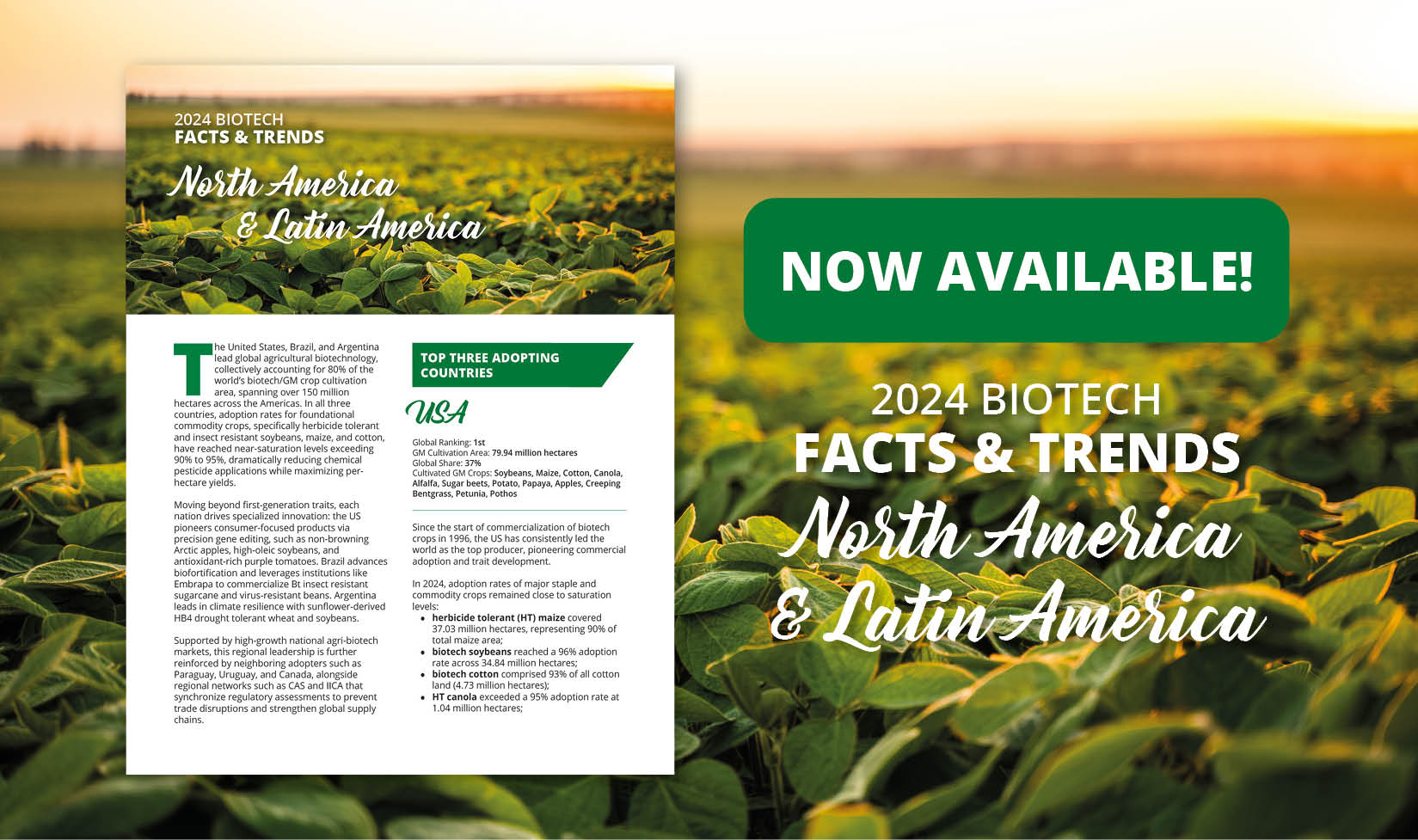
Each of the top three producers brings distinct strengths and next-generation innovations. The United States pairs near-saturation adoption in crops like maize, soybeans, cotton, canola, sugar beets, and alfalfa with consumer-focused and gene-edited breakthroughs such as non-browning Arctic apples, high-oleic soybeans, antioxidant-rich purple tomatoes, and glowing petunias. Brazil is expanding beyond staple field crops into insect-resistant sugarcane and disease-resistant pinto beans, while Embrapa is advancing folate-biofortified lettuce that has drawn encouraging public support in consumer surveys. Meanwhile, Argentina maintains the world's highest overall biotech adoption rate at 83.2% and leads in climate resilience with drought-tolerant HB4 wheat and soybeans—delivering a 19.5% yield advantage under severe drought—alongside small-scale plantings of GM safflower and virus-resistant potatoes.
Across the rest of North and Latin America, a broad mix of neighboring adopters highlights how biotech/GM crops serve diverse national and export goals. In North America, Canada has high adoption of canola, maize, and soybeans, plus smaller areas of sugar beets and alfalfa, while Mexico planted GM cotton. Across Latin America, other countries that planted biotech/GM crops are Paraguay, Bolivia, Uruguay, Colombia, Honduras, Chile, and Costa Rica.
Strong regional cooperation and global trade dynamics underpin much of this cultivation. Mechanisms such as the North American Biotechnology Initiative (NABI), the 2022 International Biosafety Network of Products derived from Modern Biotechnology (linking Argentina, Brazil, Paraguay, and Uruguay), and the 2022 Argentina–Brazil biosafety cooperation agreement, help align regulatory oversight and streamline joint reviews. At the same time, international trade remains closely tied to regulatory alignment and market demand—whether Argentina requires prior approval of GM soybean events in China, or the European Union relies heavily on imported GM corn and soy for affordable livestock feed, amid more than 4,400 risk assessments over three decades confirming safety comparable to conventional crops.
The report also includes a feature, "Global Acceptance and Trade of GM Crops," written by Dr. Stuart J. Smyth from the University of Saskatchewan. The article examines the critical role of GM crops in global agricultural trade and food security, noting that unbiased surveys reveal steadily growing consumer acceptance for both GM and gene-edited foods—driven largely by inflation, affordability, and nutrition—and urges the agricultural industry to continue developing and commercializing these crops despite rising government protectionism.
Looking ahead, the report underscores that sustaining this progress requires science-based, product-focused regulation, harmonized approvals across trading partners, and broader access to climate-resilient and nutritionally enriched traits. With projected agri-biotech market growth between 2025 and 2030 in the U.S. (US$40.5 billion to US$61.5 billion), Brazil (US$11.8 billion to US$18.2 billion), and Argentina (US$4.03 billion to US$6.19 billion), agricultural biotechnology is poised to play an even larger role. Paired with precision agriculture, transparent science communication, and lower barriers for smallholder farmers, biotech innovations across the Americas offer practical pathways to strengthen food security and sustainability in a changing climate.
Explore ISAAA Biotech Facts & Trends publications for a deeper look at agricultural biotechnology trends in Asia and Oceania, Africa, and North and Latin America. The three publications are supplementary to ISAAA Brief 57: Global Status of Commercialized Biotech/GM Crops in 2024. All are available for free to Biotech Updates Elite and Corporate subscribers or for purchase through the ISAAA website for US$15 each.
| Archive | Older Post |
Science Speaks is ISAAA Inc.'s official blog. Weekly blog articles, authored by ISAAA writers, partners, and invited contributors, aim to help share, disseminate, and promote scientific knowledge and its vital role in achieving global agricultural sustainability and development. Your support to Science Speaks will help us achieve this goal. Support ISAAA by subscribing as a Premium or Elite Subscriber