

The Future of Food and Law II: Navigating Biotechnology, Policy, and the Philippine Judiciary
| |
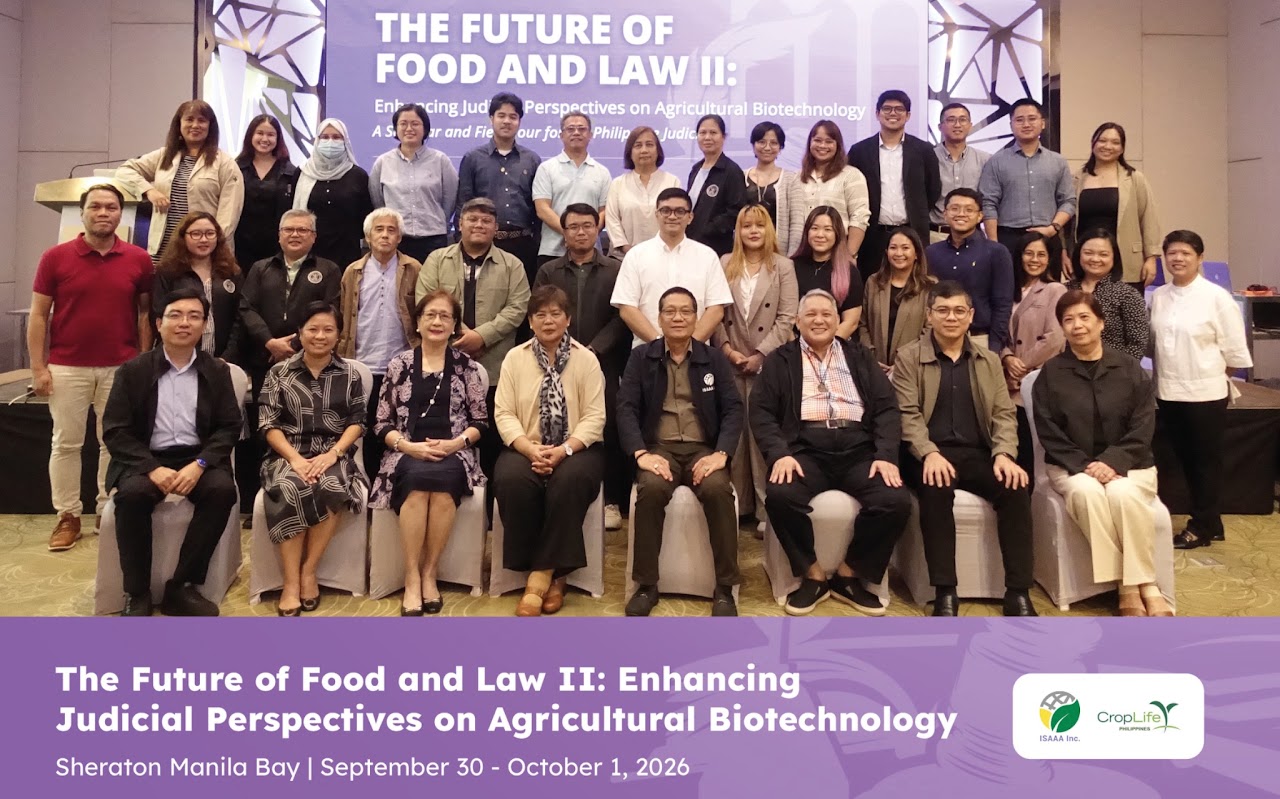
The commercialization of biotech crops in the Philippines relies on balancing rigorous regulatory frameworks with clear, science-based public understanding. When legal challenges arise, judicial rulings play a crucial role in determining whether agricultural biotechnology can advance key national goals—including food security, poverty alleviation, sustainability, and social progress.
To address these intersecting legal and procedural challenges, ISAAA Inc., in collaboration with CropLife Philippines, organized a specialized two-day activity titled The Future of Food and Law II: Enhancing Judicial Perspectives on Agricultural Biotechnology, held at Sheraton Manila Bay and Tarlac City from September 30 to October 1, 2026.
The event engaged members of the Philippine Judiciary, including representatives from the Supreme Court, the Court of Appeals, and the Philippine Judicial Academy (PHILJA). This initiative built directly upon a landmark workshop convened on September 25, 2025, by ISAAA Inc. and Bayer CropScience, Inc., where over 100 judicial, academic, and regulatory leaders called for a calibrated, risk-based application of the precautionary principle and the streamlining of judicial bottlenecks.
Rooted in experiential learning, The Future of Food and Law II bridged the gap between abstract legal concepts and practical agricultural reality. Moving beyond classroom lectures, the workshop combined high-level policy discussions with a field visit to a seed production plant facility in Tarlac City. By observing real-world biotech seed processing operations, participants gained firsthand context for analyzing regulatory issues and evaluating scientific evidence in future jurisprudence.
Day 1: Expert Insights and Science-Law Dialogue
The first day featured a seminar that brought together legal practitioners, scientists, regulators, communicators, and policy experts to explore the science, regulation, and impact of crop biotechnology in the Philippines.
Dr. Leocadio S. Sebastian, Member of the ISAAA Board of Trustees, Acting President/CEO of the Development Academy of the Philippines, and NAST Academician, delivered the opening remarks.
In his message, Dr. Sebastian highlighted that technology has provided solutions to many global challenges, with key breakthroughs driven by biotechnology—particularly in agriculture through the development of pest-, disease-, and climate-resilient crops. He also emphasized that the Philippines maintains a rigorous biosafety and regulatory framework, and called on attendees to advocate for a deeper, science-informed perspective that empowers courts to evaluate complex biotechnology cases with clarity and confidence.
The Science and Impact of Bt Corn
Dr. Lourdes D. Taylo, Career Scientist 1 and Affiliate Professor at UPLB, presented the story of Bt corn in the Philippines. She highlighted corn as a vital pillar of national food security and rural livelihoods, while noting the challenges traditional production faces from devastating pests such as the Asiatic corn borer and fall armyworm, as well as the health and environmental risks of prolonged pesticide exposure.
Dr. Taylo shared that the introduction of Bt corn not only marked a historic milestone for the country as Southeast Asia's first nation to commercialize a biotech crop, but also transformed local agriculture by offering targeted insect resistance. Backed by extensive scientific consensus on safety and rigorous regulatory oversight, this innovation has empowered hundreds of thousands of Filipino farmers with higher yields, increased incomes, and safer, more sustainable farming practices.
Biosafety & Regulatory Frameworks
Mr. Reimond S. Corona, Project Senior Technical Specialist at the DOST-National Committee on Biosafety of the Philippines, discussed the Philippine biosafety regulations for genetically modified and gene-edited crops. He explained that the country enforces a science-based, case-by-case biosafety system grounded internationally in the Cartagena Protocol and nationally in Executive Order No. 514. Governed through a Joint Department Circular across multiple agencies, standard evaluations for contained use, field trials, food/feed use, and commercial propagation take 35 to 40 working days. Recent plant breeding innovations, such as gene editing, are formally assessed to differentiate between GMO and non-GMO regulatory pathways.
Health & Safety Assessment
Dr. Nina G. Gloriani, former Dean of the UP Manila College of Public Health, detailed the 10- to 14-year safety assessment process required for biotech crops. Governed by international frameworks like Codex Alimentarius, evaluations rely on comparative safety and "substantial equivalence." She noted that Bt corn’s insecticidal protein (Bacillus thuringiensis) targets specific pests without harming mammals, which lack compatible gut receptors and rapidly digest the protein.
Backed by extensive toxicological, allergenicity, and weight-of-evidence evaluations and a decade of global scientific data from 2016 to 2025 confirming no adverse health effects, both the Philippine Food and Drug Administration (FDA) and international scientific consensus validate the safety and environmental benefits of approved biotech crops, she said.
Socio-Economic Impacts
Dr. Cesar B. Quicoy, retired UPLB Professor of Agricultural and Applied Economics, shared socio-economic findings on Bt corn adoption since its 2002 commercial approval. Survey data across four major adopting provinces (Isabela, Camarines Sur, Bukidnon, and South Cotabato) showed that adoption raised farm productivity by an average of 30%. Although Bt seeds cost roughly twice as much as conventional hybrids, reduced insecticide expenses and higher market returns deliver substantial net welfare gains to farmers.
Future Frontiers: High Iron and Zinc Rice
Dr. Reynante L. Ordonio, Career Scientist I/Senior Science Research Specialist at the DA-Crop Biotechnology Center, presented the development of High Iron and Zinc Rice (HIZR), aimed at reducing child stunting and anemia. Following successful trials, the lead event (HIZ039) gained official approval for commercial propagation in April 2026, with next steps focusing on varietal registration, field deployment, and nutritional evaluation.
Open Discussion
An interactive Q&A session was moderated by Mr. Panfilo De Guzman, Deputy Director of ISAAA Inc. Panelists included the resource speakers, Dr. Ernelea P. Cao (Professor Emeritus at UP Diliman) and Atty. Damcelle T. Cortes (Assistant Professor at UPLB).
Key takeaways from the panel discussion included:
- Evaluating scientific evidence: When presented with conflicting peer-reviewed scientific studies and opposing expert testimonies, courts should apply a "weight of evidence" approach—evaluating combined datasets (toxicology, epidemiology, safe-use history) rather than relying on isolated studies. Judicial training should focus on strengthening the evaluation of scientific evidence.
- Regulation and public transparency: Philippine biosafety is subject to multi-agency oversight under the Joint Department Circular. Public participation is embedded early via community representatives on institutional biosafety committees, local-language postings, public hearings, and local government approvals.
- Addressing public perception: Misgivings are largely driven by fear of novelty, alarming terminology ("toxins"), and fear-mongering, as well as broader philosophical debates on seed sovereignty and corporate control. Transparent communication and early science education are key to building public trust.
- Economic trade-offs: Higher initial seed costs are offset by lower pesticide and labor expenses. By preventing 30%–50% crop losses, biotech crops stabilize local supply and reduce reliance on imports.
- Legal obstacles and modern techniques: Litigation, such as the Writ of Kalikasan, has historically stalled commercial deployment despite prior safety approvals. To avoid ongoing procedural delays, researchers are increasingly adopting gene editing techniques, which follow streamlined, non-GMO regulatory pathways.
Day 2: Experiential Learning in Tarlac City
On the second day, participants transitioned from classroom lectures to direct field observation during a facility tour of the Corteva Agriscience Production Plant in Tarlac City.
Dr. Antonio A. Alfonso, Asia Pacific Regional Regulatory Manager at Corteva Agriscience (now Vylor), highlighted the critical role of biotech corn in supporting the country's livestock and feed industries. He explained that yellow corn makes up 50%–60% of local livestock and poultry feed, with genetically modified (GM) varieties comprising roughly 75% of that supply. Dr. Alfonso emphasized that scalable agricultural innovations are essential for stabilizing grain supplies and reinforcing long-term national food security.
During the facility tour, participants walked through the full seed processing lifecycle and observed the rigorous quality control measures, precise labeling standards, and safety protocols required before seeds receive commercial market clearance.
In his closing message, Mr. Panfilo G. De Guzman thanked the participants for their commitment to shaping a legal environment that supports a secure, sustainable agricultural future. He noted that while agricultural biotechnology is essential for climate resilience, food security, and sustainability, it introduces complex legal questions regarding intellectual property, environmental compliance, and liability. Legal frameworks must foster responsible innovation rather than stifle scientific progress.
Conclusion
As agricultural biotechnology advances from insect-resistant crops to biofortified foods and precision gene editing, informed judicial perspectives are more vital than ever. The insights gained from The Future of Food and Law II lay a strong foundation for a predictable, science-based legal framework—one that resolves procedural bottlenecks, upholds safety standards, and ensures biotechnology can deliver on its promise to support Philippine food security and economic growth.
| Archive | Older Post |
Science Speaks is ISAAA Inc.'s official blog. Weekly blog articles, authored by ISAAA writers, partners, and invited contributors, aim to help share, disseminate, and promote scientific knowledge and its vital role in achieving global agricultural sustainability and development. Your support to Science Speaks will help us achieve this goal. You can help us by donating as little as $10.