

Most Trending Agri-biotech News in 2025
| |
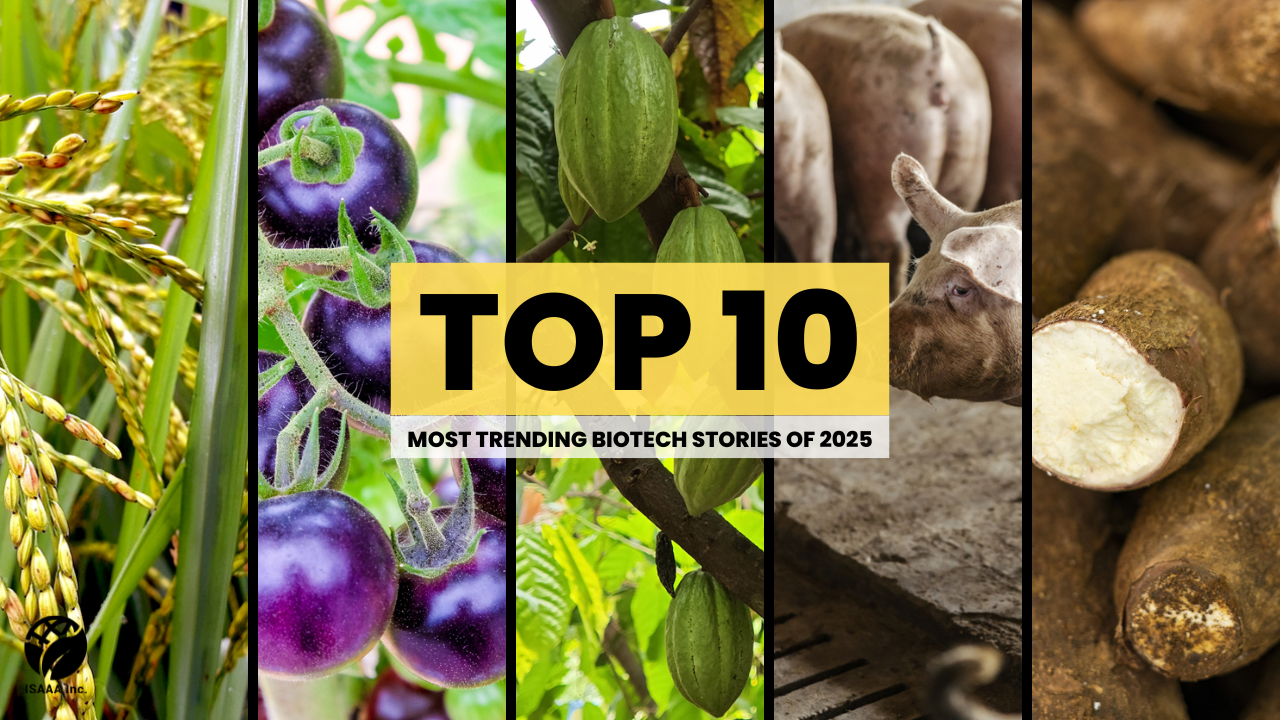
Throughout 2025, our e-newsletter, Biotech Updates, highlighted the most significant advancements and events in biotechnology. From swine fever-resistant pigs, disease-resistant cacao, to color-changing tomatoes, these stories sparked global interest! As we jump into another year of reporting, let us look back and see which biotech news received the highest engagement.
This article presents the top 10 most trending Biotech Updates articles based on social media views and shares. Read on and check which news made it to the top of the list!
10 Gene Editing Leads to Rice Sheath Blight Resistance and Yield Increase
Researchers at Shenyang Agricultural University used CRISPR-Cas9 to precisely edit the DEP1 gene in japonica rice, discovering that a truncated mutation provides superior resistance to sheath blight compared to a full gene deletion. Unlike the full deletion, which reduced productivity, this specific truncated version simultaneously increased crop yield, effectively overcoming the common biological trade-off between plant defense and growth. This breakthrough demonstrates that fine-tuning genetic sequences, rather than simple gene deletion, can create better rice varieties that are both hardier and more productive.
9 Pakistan Approves GM Sugarcane and GM Cotton for Commercialization and GM Canola for Food, Feed, and Processing
Pakistan’s National Biosafety Committee has officially approved the country’s first GM sugarcane and advanced cotton varieties for commercial use. The approved sugarcane lines, CABB-IRS and CABB-HTS, were found safe for the environment and human health. Additionally, two new GM cotton varieties were cleared, featuring built-in resistance to pests like bollworms and tolerance to the cotton leaf curl virus. The committee also granted import permission for 43 GM canola events for food, feed, and processing, specifically highlighting varieties with heart-healthy fatty acid profiles. These decisions represent a significant step forward in Pakistan's effort to leverage biotechnology for improved agricultural sustainability and food security.
8 MIT Chemists Boost Rubisco's Efficiency for Photosynthesis
The enzyme Rubisco catalyzes the incorporation of carbon dioxide into organic compounds to create sugars during photosynthesis. However, Rubisco catalyzes only one to 10 reactions per second compared to the other enzymes involved in photosynthesis. To improve Rubisco, chemists at the Massachusetts Institute of Technology (MIT) team used a mutagenesis technique called MutaT7. This technique allows researchers to perform both mutagenesis and screening in living cells, enabling them to mutate the target gene faster.
7 Study Reveals Extreme Dwarfism in Wheat Impairs Gluten Composition and Baking Quality
While the introduction of dwarfing genes significantly boosted global wheat yields and crop resilience, a study by the Technical University of Munich reveals that extreme dwarfism negatively impacts flour quality. The researchers reported that extremely dwarf varieties possess an unfavorable gluten composition compared to semi-dwarf or tall wheat, which resulted in dough that is too soft for optimal baking. This change in the dough quality is primarily caused by an altered gliadin-glutenin ratio, a trait specifically linked to certain extreme dwarfing genes. Despite these genetic findings, the study also emphasized that environmental factors like heat and humidity during grain development play an even larger role in compromising gluten integrity.
6 CRISPR-Cas9 Helps Enhance Cassava's Disease Resistance, Drought Tolerance, and Starch Biosynthesis
In the Gene Editing Supplement, the most trending news was about gene-edited cassava. Researchers from the Chinese Academy of Sciences edited critical genes associated with cassava mosaic disease (CMD), cassava brown streak disease (CBSD), drought stress response, and starch biosynthesis. This research has significant implications for global food security, particularly in developing countries where cassava is a staple crop.
5 Cornell Students Develop Color-changing Tomato
Cornell University doctoral students Jacob Belding and Ava Forystek successfully developed bioengineered tomato plants that turn vivid red when the soil nitrogen levels are low. Dubbed as RedAlert Living Sensors, the color-changing tomato plants were designed to help gardeners, farmers, and hydroponic growers know when their plants need more nitrogen to grow. RedAlert Living Sensors is one of the finalists in the Collegiate Inventors Competition organized by the National Inventors Hall of Fame.
4 BRIC-NIPGR Develops Gene-Edited Rice with Improved Phosphate Uptake and Grain Yield
India relies on phosphate fertilizers to support crops such as rice, but only 20% of the applied phosphate is absorbed by rice plants. Thus, researchers from the BRIC-National Institute of Plant Genome Research used gene editing and developed rice lines with improved phosphate uptake and grain yield, even in low phosphate soil conditions.
3 Australian OGTR Invites Comments for the Commercial Release of GM Purple Tomato
Last year, Australia's Office of the Gene Technology Regulator (OGTR) received a license application from All Aussie Farmers for the commercial cultivation of genetically modified (GM) purple tomatoes, which have boosted levels of anthocyanin. The OGTR has prepared a Risk Assessment and Risk Management Plan (RARMP) for the application and invited comments from the public to be considered for approval.
On January 6, 2026, the GM purple tomato was approved for commercial use throughout Australia.
2 Experts Develop Gene-Edited Pigs Resistant to Classical Swine FeverExperts from the University of Edinburgh developed pigs with resistance to classical swine fever, thanks to gene editing. The research team edited a pig protein that prevents the virus from reproducing inside pig cells. Since classical swine fever continues to cause major outbreaks across Asia, Africa, Latin America, and Europe, the findings could help lessen trade restrictions and financial losses faced by farmers.
1 CRISPR Produces Disease-resistant Cacao PlantsThe most trending article in the Biotech Updates in 2025 is about the disease-resistant cacao plants, which was shared 365 times and had over 128k views.
Pennsylvania State University researchers successfully developed gene-edited cacao plants with resistance to black pod disease, one of the biggest problems in the global chocolate industry. Through CRISPR-Cas9 technology, the researchers targeted a gene that works as a molecular “brake” on the plant’s natural defense system.
Upgrade Your Access to Biotech Updates
Get ahead of biotech news, research highlights, and regulatory updates in 2026. Get a Premium or Elite subscription plan and receive exclusive access to the upcoming ISAAA report on global adoption of biotech/GM crops in February! Visit https://www.isaaa.org/subscribe/ now.
| Newer Post | Archive | Older Post |
Science Speaks is ISAAA Inc.'s official blog. Weekly blog articles, authored by ISAAA writers, partners, and invited contributors, aim to help share, disseminate, and promote scientific knowledge and its vital role in achieving global agricultural sustainability and development. Your support to Science Speaks will help us achieve this goal. You can help us by donating as little as $10.