
Empowering Asia through Agribiotechnology Training
Agricultural biotechnology has immense potential to foster sustainable agriculture. However, realizing this potential depends on robust research and development (R&D) and on crucial supporting elements, such as effective communication, well-defined science-based national regulatory frameworks, and a thorough grasp of international legal instruments. Strong collaboration among scientists, regulators, policymakers, and legal experts is vital. This ensures that scientific advancements and regulatory practices evolve hand-in-hand, allowing society to reap the benefits of modern biotechnology while effectively minimizing risks.
The Asian Short Course on Agribiotechnology, Biosafety Regulation, and Communication (ASCA) is a key capacity- building initiative designed to equip Asian scientists and regulators with expertise in biotechnology policies and regulations. This program is a collaborative effort between the International Service for the Acquisition of Agri- biotech Applications, Inc. (ISAAA Inc.) and the Malaysian Biotechnology Information Centre (MABIC).
ASCA aims to foster a unified, science-based voice in support of regulations that promote biotechnology R&D, commercialization, and trade. It also addresses the critical need for training Asian biotech players, especially given the resource constraints often faced by developing countries.
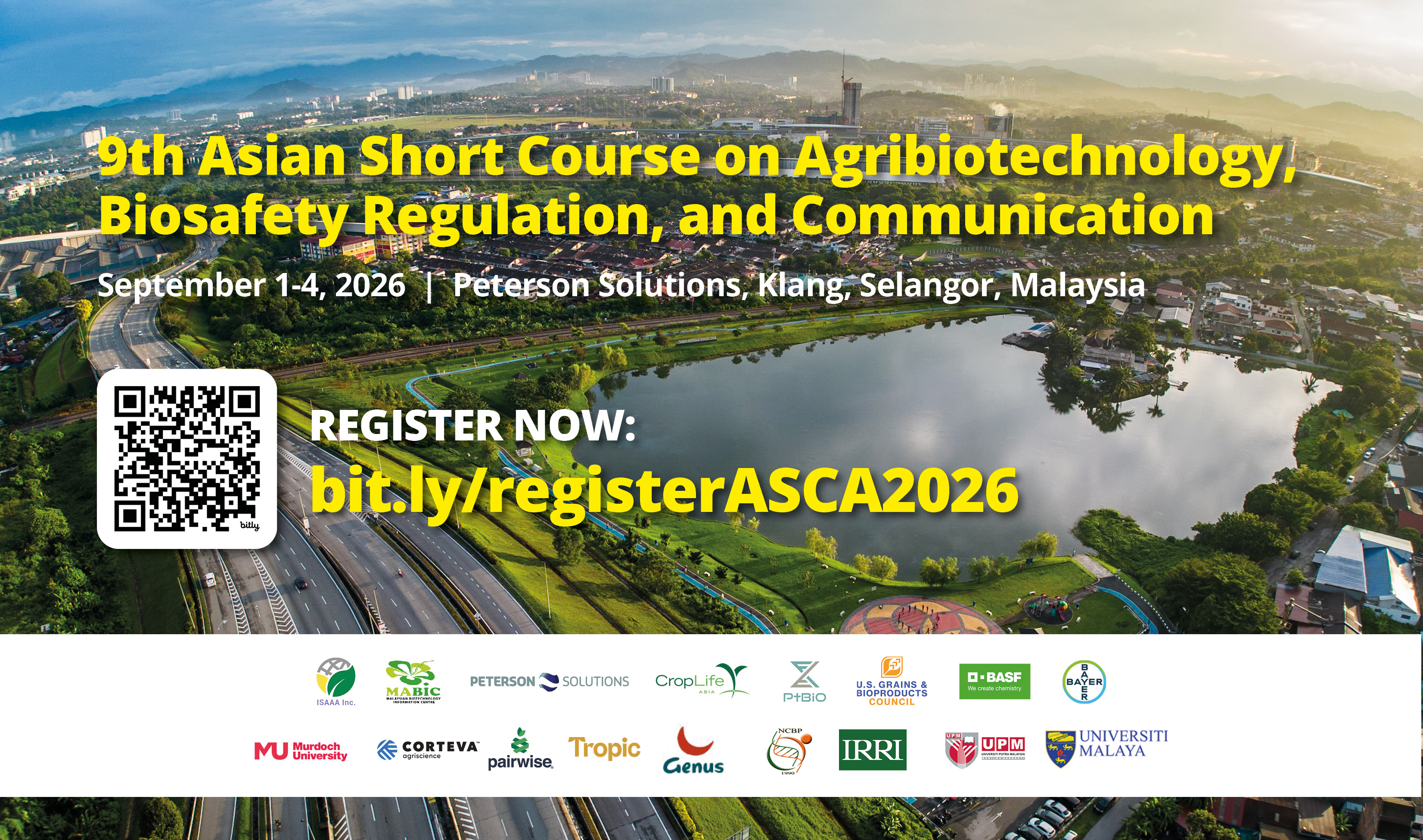
The 9th Asian Short Course on Agribiotechnology, Biosafety Regulation, and Communication (ASCA2026) will take place from September 1-4, 2026, at Peterson Solutions, Klang, Selangor, Malaysia.
ASCA has a history of successful events across the region, including in Malaysia (2018), the Philippines (2019, 2022, 2025), Indonesia (2023), and Thailand (2024), as well as virtual sessions in 2020 and 2021. Since its inception, more than 250 participants have completed the short course.
The short course is focused on the following themes:
- The Frontier of Agricultural Biotechnology - covers evolution, current trends, and next-generation innovation.
- Navigating Global Regulatory Frameworks - focus on environment, food safety, and international trade
- Genome Editing: Science, Policy, and Commercialization - includes precision breeding and market access
- Public Engagement, Stewardship, and Strategic Communication - features perception, advocacy, and knowledge sharing
Strategies of the Course
Registered participants undergo an intensive four-day program featuring three days of agricultural innovation education followed by a dedicated day of laboratory and field visits. Throughout the course, expert scientists provide firsthand conceptual insights into the development of modern crop, animal, and microbial innovations, such as genetic modification and genome editing, and track their journey from the laboratory to the market.
Learning is maximized through a dynamic mix of lectures, discussions, specialized information materials, exercises, and interactive assignments that explore the science, practical applications, benefits, and economic impacts of these technologies. Finally, the course topics incorporate hands-on laboratory demonstrations and direct farm field visits to ensure an enhanced, well-rounded understanding of modern agricultural advancements.
Registration and Fees
The registration fee for ASCA2026 is as follows:
| Category | Registration Fee |
| International | US$1,000 |
| Malaysia-based | US$800 |
The registration fee covers the following:
• Lunch and snacks throughout the workshop, and a welcome dinner on the first day
• All transportation for organized visits to biotechnology farms and research institutions
• Complete access to workshop materials and training kits
The registration does not include accommodation, airfare, or any charges associated with fund transfers.
Payments can be made via PayPal or bank transfer. For inquiries about alternative payment methods, please email meetings@isaaa.org.
Register now at bit.ly/registerASCA2026.