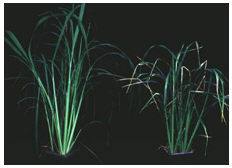
Source: John Innes Centre
|
|
|
Source: John Innes Centre |
Rice yellow mottle virus (RYMV) is of major concern especially among African rice farmers since rice is one of Africa’s staple foods. It has been estimated that rice yield loss to RYMV in
Africa could be as much as 94% for susceptible lowland cultivars and 54% among tolerant upland cultivars. Typical symptoms of the disease are yellowing, mottling and stunted leaf growth leading to sterile or unfilled grains. Weakened plants are then susceptible to other fungal, viral, or bacterial rice pathogens.To combat this disease, researchers are enhancing the plant’s antiviral defense system by incorporating mRNA sequences of the virus into rice plants, consequently make them immune to the pathogen.
In much the same way vaccines immunize humans against different diseases, modern biotechnology allows scientists to insert small fragments of plant viral DNA into crops. This develops natural protection or immunity against those viruses.
This pathogen-derived resistance mechanism has been found to naturally occur in plants and is similar in theory to the immune system of mammals. In cases where gene expression of a pathogen was found to be dysfunctional, in excess or progressed at the wrong developmental stage of the pathogen’s life cycle, development of the disease is prevented. In the case of RYMV resistant rice, the transgenes that are introduced were taken from highly conserved sequences of the RNA-dependent RNA polymerase of RYMV genome. This polymerase enzyme plays an important role in viral replication. The transgene activates a sequence-specific RNA degradation system in the rice such that when RYMV infects a resistant rice variety, the viral RNA will be destroyed when detected. This technology is also called RNA silencing.
For more information on the technology developed at John Innes Centre, please contact Dr. Yvonne M. Pinto (email: y.pinto@gtep.co.uk), The Cereals Research Department, John Innes Centre, Colney Lane, Norwich, Norfolk, NR 47 UH, UK.
