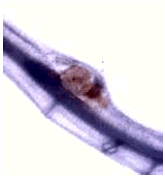
Source: Plant Nematology Lab, University of Leeds
|
|
|
Source: Plant Nematology Lab, University of Leeds |
Nematodes are another economically important rice pest. They are prevalent in Asia and Africa causing up to 70% yield loss to upland and lowland rice. There is a great need to develop nematode-resistant rice varieties, as previous chemical methods to reduce nematode infection are considered ecologically destructive. Nematicides pose great threat to none target organisms, to our aquatic ecosystems, drinking water supplies, and to the ozone layer.
Other indications of nematode infestations in rice are: slow growth, reduced plant height reducing tillering, and the panicles become crinkled and empty.
The Plant Nematology Lab (http://www.biology.leeds.ac.uk/nem/home.htm) of the University of Leeds (UK) (http://www.leeds.ac.uk/) has been developing nematode-resistant rice based on an anti-feedant approach. They are enabling rice plants to specifically produce the natural proteinase inhibitor, cystatin in the roots or in cells attacked by nematodes. This innocuous plant-derived proteinase inhibitor prevents the nematode from feeding efficiently. They have incorporated root specific promoters to ensure that the gene product is expressed only in the roots and not in green tissues or seeds of rice. Cystatin is non-toxic, is not involved in mammalian digestion, and is naturally occurring such that it can be found in rice grains, and is commonly used by plants against other pests and insects.
They are also developing ways to target specifically the nematode’s specialized feeding cells from functioning efficiently when they feed on modified root cells of rice.
