Issues and Status
Issues
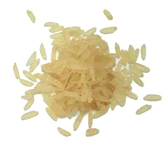 Golden RiceTM has the potential to improve the lives of
millions of the poorest people in the world. However, the question now
is ‘will it ever reach those for whom it was intended?’ It will not be
easy because the technology is caught up in a myriad of hopes and fears,
and not to mention a handful of patents.
Golden RiceTM has the potential to improve the lives of
millions of the poorest people in the world. However, the question now
is ‘will it ever reach those for whom it was intended?’ It will not be
easy because the technology is caught up in a myriad of hopes and fears,
and not to mention a handful of patents.
Research into Golden Rice is still at its early stages and it will take
time before we know whether the benefits it claims to offer will be realized.
For more, read what Ingo
Potrykus, Golden Rice's inventor, has to say about his creation.
Status
Despite the success of Golden RiceTM and all the media attention, the
new crop is not yet ready for market. On the contrary, the collaborators
do not expect it to be available for local planting and consumption until
2003 at the earliest. There is plenty of work still to do. The researchers
used the japonica variety of rice for their experiments, while indica
rice is the most common commercial strain. Scientists in Asia will now
take on the task of crossbreeding the new strain with local rice varieties
and field-testing the hybrids. As for the complex patent issue behind
the Golden RiceTM technology, there have now been bold efforts from the
private sector to help make it available in developing countries.
In May 2000, the inventors reached an agreement with Zeneca and Greenovation,
a German company acting as intermediary for the inventors. Zeneca pledged
to provide regulatory, advisory and research expertise to help make Golden
Rice™ available in developing countries. Under the agreement, Zeneca will
give the inventors patent rights for use in developing countries in exchange
for the right to sell Golden Rice™ to farmers in wealthy countries. More
recently, Monsanto Co., one of the many patent holders, said it would
waive its patent rights unconditionally. Hopefully, with the examples
of Zeneca and Monsanto Co, other companies will fall into line behind
Golden Rice™.
