
CROP BIOTECH UPDATE
---------------------------------------------------------------------------
A weekly summary of world developments in agri-biotech for developing countries, produced by the Global Knowledge Center on Crop Biotechnology, International Service for the Acquisition of Agri-biotech Applications SEAsiaCenter (ISAAA)
---------------------------------------------------------------------------
July 10, 2009
In This Week’s Issue:
News
Africa
• Nigeria: Field Trials of New Yam Growing Technique Begins
• Biotechnology Communication Course in Kenya
• Role of Genetically Modified Crops in Africa
Americas
• New Technical Committee for GMOs in Mexico
• ARS Releases Corky Root-Resistant Lettuce Lines
• Spicy Compound Keeps Plant Pathogenic Fungi Out
• Cargill Opens New Specialty Canola Research and Production Centre
• Pioneer Hi-Bred Announces New North Carolina Research Center
Asia and the Pacific
• Vietnam Sets up First Biofuel Plant in PhuTho
• Should India Commercialize GM Rice with or without China?
• India Boosts Import for R&D of Transgenic Crops
• China Discusses Benefits of GM Crops with Media
• PTTC in India to Shepherd Transgenic Crops
Europe
• UK Establishes New Genome Center
• France Rejects EFSA’s Opinion on GM Maize
• German Parliamentarians Vote Against Permanent GM Maize Ban
• BASF Partners with Cologne University to Develop Drought-Proof Crops
Research
• Researchers Shed Light on Mechanism of Plant Root Growth
• Bollworms Can Overcome Insecticidal Proteins in GM Cotton, Scientists Say
• Scientists One Step Closer to Developing Crops that Thrive in Problematic Saline Soils
Announcements
• Africa's Engine for Growth - Plant Science and Biotechnology Hold the Key
Document Reminders
• JRC Releases Report on the Global Pipeline of New GM Crops
----
NEWS
----
Africa
NIGERIA: FIELD TRIALS OF NEW YAM GROWING TECHNIQUE BEGINS
The International Institute of Tropical Agriculture (IITA), in collaboration with Nigerian farmers, has begun field trials of a new technique in propagating yam. The new technique, developed by the IITA and the Tokyo University of Agriculture, uses vine cuttings planted in carbonized rice husk (CRH). CRH is a growth medium which could be obtained by farmers cheaply, if not for free. The technology eliminates the use of tubers as seed, thus, more yams are made available for food and sale. This also minimizes nematode infestations, a main cause of low yields in yams, and promotes faster multiplication and better and more uniform crop quality.
"The technology will save farmers the cost and difficulty of acquiring seed yams," says Joshua Aliyu, a researcher at the Niger State Agricultural Development Project working on the trials. "It would be a rebirth of yam cultivation in our community," he adds. FAO estimates that West Africa accounts for 97 percent of world yam production. The cost of seed yams in the region, however, accounts for about 50 per cent of the total cost.
The complete article is available at http://www.iita.org/cms/details/news_feature_details.aspx?articleid=2543&zoneid=342
The Kenya government is now paying more attention to building capacity for communicating agricultural biotechnology issues more effectively and in a coordinated manner. During a two-day Biotechnology Communication training course for senior personnel in the Ministry of Agriculture, Dr. Wilson Songa, the Agriculture Secretary, underscored the need to shift attention to identifying and addressing pertinent concerns and reservations that various stakeholders may have on the technology. He emphasized the importance of communicating to stakeholders the benefits of using biotechnology products, and also the impressive progress of GM crops research in the country. Assuring the participants of Government's commitment in fast tracking completion of implementing regulations for operationalizing the recently enacted (February 2009) Kenya Biosafety Act, he said safe and responsible use of GM technology will be the guiding principle. "The Government will ensure all genetically modified products grown or traded in the country are thoroughly tested and conform to the highest international safety standards for both humans and the environment," he said.
The Communication course, which was held at the Africa Institute for Capacity Development (AICAD) on June 22nd -23rd 2009, was organized by the International Service for the Acquisition of Agri-biotech Applications (ISAAA) AfriCenter in collaboration with the Program for Biosafety Systems (PBS) and the National Council for Science and Technology (NCST). The aim of the course was to contribute towards strengthening capacity for implementation of the National Biotechnology Awareness Creation Strategy (BioAWARE). The strategic goal of BioWARE is to improve public awareness on all aspects of biotechnology through dissemination of accurate information and provision of guidelines to enhance informed decision making processes. The course also sought to equip participants which included senior Ministry head-office Directors, Provincial Directors of Agriculture, Parliamentary Liaison staff and Public Relations Officers with the knowledge and skills to respond authoritatively and speedily to concerns and issues surrounding implementation of the Biosafety Act. The Agriculture Secretary also reiterated Government's commitment to exploring means and ways of utilizing all available and proven technologies in helping Kenya achieve food security and combat poverty.
For details and information on biotechnology in Africa, contact Margaret Karembu, director of the East and Central Biotechnology Information Center (ECABIC) at africenter@isaaa.org
Mexico's Secretariat of Agriculture, Livestock, Rural Development, Fishery and Food (SAGARPA) announced that it has agreed to establish a new technical and scientific committee for genetically modified organisms (GMOs). The Committee will support SAGARPA in the analysis of petitions and notices related to GMOs, in accordance with the Mexican biosafety law. The Committee will also issue technical opinions on the potential risks of GMOs on animal, plant and aquaculture health. The Committee will be headed by a President, who will be designated by the Agriculture Secretariat, and an Executive Director.
The USDA Foreign Agricultural Service Report is available for download at http://gain.fas.usda.gov/Recent%20GAIN%20Publications/Mexico%20Creates%20Technical%20Committee%20for%20GMOs_Mexico_Mexico_6-25-2009.pdf
The US Department of Agriculture's Agricultural Research Service (ARS) has released three new lettuce breeding lines with resistance to corky root, a serious lettuce disease caused by the bacterium Sphingomonas suberifaciens. Infection of the bacterium causes lettuce roots to expand and develop yellow to brown lesions and longitudinal cracks, taking on a cork-like appearance. This results to severe yield loss since the roots are unable to effectively absorb water and nutrients.
The corky root-resistant lettuce lines, developed by ARS scientist Beiquan Mou, also showed little to no tipburn in test trials. Tipburn is caused by calcium deficiency in young, growing leaves. This defect severely limits the appearance and shelflife of lettuce, especially if the lettuce is to be used for salad mixes as there is zero tolerance for defects.
For more information, read http://www.ars.usda.gov/is/pr/2009/090707.htm
Dried, ground cayenne peppers can give a dull dish an extra kick. Now, researchers at the USDA Agricultural Research Service (ARS) found that the humble pepper can do more than that. The research team said that a compound in cayenne, called CAY-1, holds promise for dual use as an antifungal in both agriculture and medicine.
CAY-1 can kill phytopathogenic fungi by damaging fungal cell membranes. It may also enter fungal cells, and adversely affect certain signaling pathways that, in turn, damage the mitochondria. The scientists proved the efficacy of CAY-1 in controlling plant pathogens. CAY-1 was lethal during the early spore germination cycle of fungi pathogenic to grapes, according to the researchers. The team is doing further research to learn if, and how, the compound could be used safely on grapes.
The original story is available at http://www.ars.usda.gov/News/docs.htm?docid=1261
The Cargill Specialty Canola Oils Research and Production Centre will be opened in Cargill's research farm, located about 50 kilometers from its canola crush facility in Clavet, Saskatchewan, Canada. "The research and production centre will allow us to help our customers develop new products and formulations designed to improve functionality, and deliver nutritional value for their products using a proven identity preservation system that results in an assured supply of product", says Jenny Verner, president of Cargill Specialty Canola Oils.
The research and production centre which was initially opened in 2008 will allow Cargill to centralize its hybrid breeding program in the heart of the commercial production region, while giving growers and customers a state of the art facility for furthering knowledge in canola production.
For details on the press release which also contains canola product releases, view: http://www.cargill.com/news-center/news-releases/2009/NA3016698.jsp
A new research center in eastern North Carolina called the Center for Dryland Research – Coastal Plains will be opened by the Pioneer Hi-bred, a DuPont business that will be dedicated to better address product development for southeastern environments. "The new Pioneer research center will further expand the company's commitment, providing better products that fit the specific needs of the region," says Greg Wichmann, Pioneer southern business unit director. The facility will involve product development and testing of both corn and soybeans with emphasis on conventional and transgenic developmental approaches in water-stressed environments.
For details, see press release at: http://www.pioneer.com/web/site/portal/menuitem.a6eb7940cfea0375a323a323d10093a0/
Vietnam's National Assembly Vice Chairwoman Tong Thi Phong led the ground-breaking ceremony to build northern Vietnam's first bio-ethanol plant in the midland province of Phu Tho. The US$80 million project is scheduled to become operational by December 2010 and will produce 100,000 cu. m of ethanol a year from cassava and sugarcane.
The project investor, Bio-Petroleum and Petrochemical Joint Stock Company (PVB), will sign direct contracts with farmers to buy their products at prices equivalent to those available at northern border gates, said director Vu Thanh Ha at the ceremony. The country produces between 15,000 and 30,000 liters of ethanol a day by small-scale factories using out-of-date technology in southern and central regions.
See the full article at http://www.nhandan.com.vn/english/business/220609/business_n.htm or email Ngoc Nguyen Bich of Agbiotech Vietnam at mailto:nbngoc78@yahoo.com for more developments on crop biotechnology in Vietnam.
An article on Balancing Productivity and Trade Objectives in a Competing Environment: Should India Commercialize Genetically Modified (GM) Rice with or without China, authored by Guillaume Gruere and colleagues at the Institute of Food Policy Research Institute, World Bank and Université de Pau et des Pays de l'Adour in France was recently published in the Journal of Agricultural Economics. The authors analyzed the economic effects of introducing GM rice in India with or without China in the presence of labeling and import approval regulations of GM food in GM sensitive countries. The results showed that the welfare gains with GM rice in India would largely exceed any potential export loss, and that the segregation of non-GM rice could help reduce the minor losses. In addition, there is no significant first mover advantage for India or China on GM rice.
The abstract of the report is downloadable and the full paper is available to subscribers at: http://www3.interscience.wiley.com/journal/122463385/abstract
A new research study Import and Commercialization of Transgenic Crops: An Indian Perspective published in the recent issue of Asian Biotechnology and Development Review (ABDR) reveals a surge in the import of transgenic materials for R&D of transgenic crops in India. Between 1997 to 2008, a total of 79 consignments of transgenic planting materials have been imported from different countries through the National Bureau of Plant Genetic Resources (NBPGR). NBPGR is a nodal agency for import and quarantine processing of transgenic planting materials for various public and private research institutions engaged in R&D of transgenic crops.
The imported crops included cabbage, Indian mustard, rapeseed, chickpea, soybean, tomato, tobacco, rice, potato, wheat and corn. Out of these imported transgenic crops, the maximum number of imports consisted of cotton followed by maize and rice. The predominant trait in these imported crops is for imparting resistance to lepidopteran insects followed by herbicide tolerance. A maximum number of transgenes have been introduced in rice including AmA1 gene and ferritin genes for improved nutrition, cry1Ac, cry1C, cry2A, cry19C and GFM-cry1A genes for resistance against lepidopteran insects, cry1Ab gene for resistance to stem borer, cp4epsps gene for herbicide tolerance, Xa21 gene for resistance to bacterial leaf blight, PR genes for resistance to sheath borer, bar gene for resistance to glufosinate ammonium herbicide, HAS, ScFv & AFP-AG genes for nematode resistance, and the genes for phytoene synthase, phytoene desaturase, and lycopene cyclase involved in the synthesis of β-carotene in the endosperm of golden rice.
The study examines the pattern of import in a range of crops for different traits over the last decade and attempts to understand the gap between the pace at which the transgenic crops are being imported by public and private sectors and their actual commercialization.
The study concludes that harnessing optimum benefits of transgenic crops while sustaining our valuable biodiversity hinges on systematic development, import and commercialization of transgenic crops along with strong public and private sector collaboration. It also addresses the concerns regarding potential impacts of transgenic crops on environment and human health and proposes to make a strong collaboration between public and private sectors to adequately address the biosafety issues.
For a full copy of the study, contact Dr. Gurinder Jit Randhawa at gjr@nbpgr.ernet.in Visit Asian Biotechnology and Development Review (ABDR) website at http://www.ris.org.in/abdr.html For more information about biotech development in India contact b.choudhary@cgiar.org and k.gaur@cgiar.org
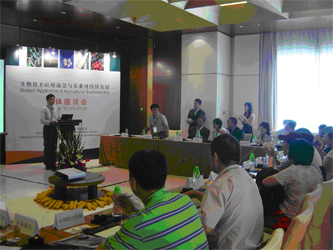
"Do GM crops benefit the producer or the consumer?" This was the main concern of communication practitioners during the media workshop held by the Chinese Society of Biotechnology (CSBT) and the China Biotechnology Information Center (ChinaBIC) of the International Service for the Acquisition of Agri-biotech Applications at Pangu 7 Star Hotel, Beijing on July 9, 2009. More than 20 journalists from trade and general/business media attended the workshop. "Biotechnology Application Prospect and Agricultural Sustainable Development" aimed to set up and strengthen the relationship between public/private sector and key media, and create a good information environment.
Prof. Zhu Zhen, vice president of CSBT and member of the Expert Council of ChinaBIC, officiated the workshop. Prof. Lin Min, director general of Biotechnology Research Institute, Chinese Academy of Agricultural Sciences, presented the biotechnology research accomplishments and application prospects in China. He stressed that "biotechnology is a crucial complement to conventional technology. The development process for biotechnology industrialization should not be blocked." Mr. Mike Frank, vice president, Monsanto Company and President, Monsanto Greater China, briefed the media on the biotechnology progress abroad. Resource persons were unanimous in saying that the first generation GM crops directly benefits farmers while consumers will also gain from the next generation of GM crops.
For more information on the Chinese agri-biotech industry, contact Prof. Zhang Hongxiang of ISAAA ChinaBic at zhanghx@mail.las.ac.cn
Translate transgenic science and technology and harness its products to meet the needs of agricultural growth. This is the mission of the Platform for Translational Research on Transgenic Crops (PTTC), a joint initiative between the International Crops Research Institute for the Semi-Arid Tropics (ICRISAT) and India's Department of Biotechnology. "PTTC will evaluate potential new genetic engineering options through collaborative participation of relevant institutions and advance them in a focused way to meet specific objectives for enhancing agricultural productivity." says Dr. Kiran Sharma, ICRISAT principal scientist.
The PTTC will work on priority crops for India and will be the locus for the basic infrastructure for research, training and outreach activities. A series of specialized satellite centers with existing experimental expertise, equipment and facilities in each region will be set up. The PTTC "will serve as a facility of reference to strengthen national, regional and international linkages and collaborations in transgenic research and development, exchange of materials and information, and to support training, consultation and technology commercialization.
The PTTC complex is currently being built at ICRISAT with initial infrastructure to be completed in 2010.
Email Dr. Kiran Sharma for additional information at k.sharma@cgiar.org.
Breeding of new crops with increased tolerance to drought, breeding of livestock able to resist emerging exotic diseases and production of antibiotics to fight ‘superbugs', are among the studies that will be conducted in a new center established by the British Biotechnology and Biological Sciences Research Council (BBSRC). The £13.5M (US$ 22M) Genome Analysis Centre (TGAC) will focus on deciphering the genomes of plants and animals used in agriculture.
A key aim for TGAC is to combine world-class genome science with an innovation program that aims to benefit the regional and national economy, the BBSRC said in a press release. The center is based at Norwich in England. Speaking about the opening, UK's Minister of State for Science and Innovation, Lord Drayson said: "The UK is a world leader in genomics, which is increasingly essential to understanding how to tackle the challenges we face in food security, the development of eco-friendly fuels and fighting superbugs".
Read the press release at http://www.bbsrc.ac.uk/media/releases/2009/090703_new_national_genome_centre_launched.html
The European Food Safety Authority's (EFSA) GMO Panel has recently released a scientific opinion on the safety and renewal of authorization for continued marketing of the GM maize MON810 in Europe. EFSA concluded that the insect-resistant maize, the only genetically modified crop approved for cultivation in the European Union, "is as safe as its conventional counterpart with respect to potential effects on human and animal health."
However, France has rejected EFSA's opinion, according to a report by the Agence France-Presse (AFP). The country's ecology and agriculture ministries said EFSA had failed to "take into account requests to change the way it evaluated the risk."
In a joint statement, the French ministries pointed out that "the conclusions of the European Council of Environment Ministers must be respected." The Council of Environment Ministers had called on EFSA to change its assessment methods. "EFSA's opinion could not take these assessment methods into account, since they are still being reviewed," the ministries said. France, together with Greece, Hungary, Luxembourg, Austria and recently Germany, has banned the cultivation of MON810, saying the GM maize poses danger to the environment.
Read the press release (in French) at http://agriculture.gouv.fr/sections/presse5022/communiques/avis-8217-aesa-sur EFSA's scientific opinion is available for download at http://www.efsa.europa.eu/cs/BlobServer/Scientific_Opinion/gmo_op_ej1149_maizeMON810_finalopinion_en.pdf?ssbinary=true
A majority of the members of the German Parliament (Deutscher Bundestag) rejected the motion by the country's Green Party to vote against the European Union's re-authorization of the genetically modified maize MON810, according to a report by the European Biotech News. A great majority of parliamentarians also voted against the permanent ban of the GM maize and the Establishment of GMO-free zones in Germany. MON810, an insect resistant maize variety developed by Monsanto Company, is the only GM crop approved for cultivation across the EU's 27-nation bloc. Several EU nations, including Austria, Germany, France, Greece, Luxembourg and Hungary, have suspended the cultivation of MON810.
Read the original article at http://www.eurobiotechnews.eu/service/start-page/top-news/?no_cache=1&tx_ttnews%5Btt_news%5D=10268&tx_ttnews%5BbackPid%5D=12&cHash=1716e7d4e0
BASF Plant Science and the Botanical Institute of the University of Cologne announced that they will work together to increase the yield of crops such as soybean, rice and canola, and improve their tolerance to adverse environmental conditions like cold, drought and salinity. BASF and Cologne University will focus on developing crops that make optimum use of carbon dioxide during photosynthesis. Certain types of plants, like corn, are able to use more CO2 through an additional metabolic process. The objective of the current research project is to transfer this biochemical mechanism to other plants. Researchers at Cologne University have been successful in creating Arabidopsis plants that produce more biomass by inserting genes that encode for special enzymes. These enzymes ensure that the plant uses more carbon dioxide.
View the media release at http://www.basf.com/group/pressrelease/P-09-145
An international team of researchers, led by scientists at the University of Nottingham in the UK, has shed light on the molecular underpinnings of root growth by focusing on the phytohormone gibberellin. Plant growth is driven by two factors: cell proliferation and elongation. Gibberellin (GA) has been shown to play a linchpin role in controlling root cell elongation in the model plant Arabidopsis, but it has been unknown whether the hormone also controls root cell proliferation.
The researchers, led by Susana Ubeda-Tomás, in a paper published by Current Biology described for the first time how GA regulates the number of cells in the root in order to control root growth. GA signals the degradation of proteins DELLA, GAI and RGA, which suppress growth. Plants in which the meristems (undifferentiated cells) were made to express a mutant version of the growth-repressing protein GAI showed disrupted cell proliferation. The mutant version of this protein, gai, is not degraded by gibberellin. The scientists found that expressing gai in only one tissue, the endodermis, was sufficient to stop the meristem enlarging.
Malcolm Bennett, co-author of the paper, noted: "We have shown that gibberellin plays a crucial role in controlling the size of the root meristem, and that it is the endodermis which sets the pace for expansion rates in the other tissues."
The paper published by Current Biology is available at http://dx.doi.org/10.1016/j.cub.2009.06.023 For more information, read http://communications.nottingham.ac.uk/News/Article/Hormone-clue-to-root-growth.html
To inhibit pest resistance, some transgenic crops produce two different Bt toxins targeting the same pest. Bt cotton, for instance, produces the insecticidal proteins Cry1Ac and Cry2Ab. These toxins have very different amino-acid sequences and bind to different target sites. But results of a study conducted by scientists at the University of Arizona showed that it might be possible for some insect pests to develop resistance to two different Bt toxins produced by genetically modified cotton.
Bruce Tabashnik and colleagues were able to generate laboratory strains of pink bollworms (Pectinophora gossypiella) resistant to 420-times higher levels of Cry1Ac than normal. These strains, which were raised on a diet that contained Cry2Ab, were also resistant to the particular toxin (resistant to 240-times higher levels of Cry2Ab than normal). The scientists hypothesize that the resistance may be due to changes in an enzyme that activates the toxins.
The results of the study, published in PNAS, indicate that cross-resistance occurs between Cry1Ac and Cry2Ab in some key cotton pests. Tabashnik and colleagues however noted that "this does not pose a threat for control by the current pyramided Bt cotton of this insect." The scientists showed that larvae from the lab strains resistant to Cry1Ac and Cry2Ab survived on cotton bolls producing only Cry1Ac, but not on cotton bolls producing both toxins.
Nature magazine has quoted Tabashnik as saying: "Pyramids are not a panacea and evolution by insects is not something that scientists are going to stop."
The open access paper published by PNAS is available at http://dx.doi.org/10.1073/pnas.0901351106 An article published by Nature summarizes the findings. It is available to subscribers at http://www.nature.com/news/2009/090706/full/news.2009.629.html#B1#B1
A team of researchers from the University of Adelaide in Australia has developed a new approach in developing plants that can thrive in saline soils, bringing salt-tolerant crops a step closer to reality.

A farmer tends to her rice field in Vietnam
The Earth is one salty planet. About 70 percent of its surface is covered with water, and more than 95 percent of that water contains 35 grams of sodium chloride per liter. The accumulation of this salt in cultivated fields has been a problem since the beginning of agriculture. While irrigation has made it possible to extend agriculture to semi-arid and arid areas of land, it has also resulted in large-scale water logging and salinity. Evaporation of irrigated water leaves behind salt which accumulates over time. Land degradation due to increased salinity presently affects more than 20% of all irrigated land in at least 100 countries.
High soil salinity negatively affects the growth of many crops. Salt, for example, decreases the availability of water in the soil. Accumulation of excess salt ions in plant cells is also fatal. These ions can impair the activity of plant enzymes, inhibit photosynthesis and damage the cell membrane. Development of crop varieties resistant to salinity is an important strategy to sustain food production in many parts of the world.
Recently, a team of researchers from the Australian Center for Plant Functional Genomics (ACPFG) and the University of Adelaide's School of Agriculture, Food and Wine, developed salt-tolerant plants using a novel approach, bringing salt-tolerant crops a step closer to reality.
Their work appears in the current issue of the journal Plant Cell.
"More than 800 million hectares of land throughout the world are salt affected," said Mark Tester, leader of the study and professor at the University of Adelaide. "This amount accounts for more than 6 percent of the world's total land area."
Tester and colleagues focused on a transporter, a membrane-embedded protein that moves ions in and out of the plant cell. This particular transporter, called HKT1;1, mediates salinity tolerance by retrieving sodium ions (Na+) from the transpiration stream, therefore reducing the levels of Na+ in the shoot. The gene that codes for the transporter is particularly expressed around the plant's water conducting pipes. Mutants that lack this gene were found to be salt sensitive.
They developed Arabidopsis plants that over-express HKT1;1 in the pericycle and vascular bundle of the stele of mature roots. Na+ transport was monitored using radiolabeled sodium (22Na+).
The scientists found that over-expression of HKT1;1 in the stele reduced sodium accumulation in shoot by up to 64 percent. By contrast, they found that plants constitutively expressing the gene accumulated high levels of sodium in the shoot and grew poorly. When grown in a medium supplied with 100 mM of NaCl, the transgenic plants that over-express HKT1;1 in stelar root cells continued to thrive, whereas their non-transgenic counterparts as well as plants that constitutively express the transporter gene exhibited signs of salt stress.
The study demonstrates that manipulating transport processes in specific plant cells may be more effective in modifying the accumulation of solutes in the plant than manipulating these processes indiscriminately.
According to Tester, the same approach has been used to increase nitrogen use efficiency of crops. "We have also successfully used this approach to increase the delivery of iron and zinc to the endosperm of rice grains," says Tester. "I think it could also be used to increase the efficiency of phytoremediation."
The team is now in the process of applying this approach to develop salt-tolerant cereal crops.
"We appear to have been successful in rice and field trials are the next step. We would be pleased to move this into other crops, such as millet and wheat, where there is a clear agronomic advantage. Key is identifying the correct promoters to control the gene expression."
Tester explains that although there is natural variation for the stelar expression of these HKT1 subfamily of genes in cereals, which will confer some level of salinity tolerance by non-transgenic means, the extent of the alterations will always be limited by the natural variation available.
"This is limited or absent in some species, and could always be increased, too," says Tester. "So there is likely to be room for a GM approach in many situations."
_________________________
Møller, I.S., Gilliham, M., Jha, D., Mayo, G.M., Roy, S.J., Coates, J.C., Haseloff, J., and Tester, M. (2009). Shoot Na+ exclusion and increased salinity tolerance engineered by cell type-specific alteration of Na+ transport in Arabidopsis. Plant Cell http://dx.doi.org/10.1105/tpc.108.064568 (Open Access Paper)
Munns, R. and Tester, M. (2008). Mechanisms of Salinity Tolerance. Annu. Rev. Plant Biol. 59:651–81. http://dx.doi.org/10.1146/annurev.arplant.59.032607.092911
For more information, read the Pocket K on Biotechnology with Salinity for Coping in Problem Soils at http://www.isaaa.org/kc/inforesources/publications/pocketk/default.html#Pocket_K_No._31.htm
With the theme, Agriculture: Africa's "Engine for Growth" - Plant Science and Biotechnology Hold the Key, an international conference on Plant Biotechnology in Africa is scheduled to take place at Rothamsted Research, Harpenden, Herts, UK on 12-14 October 2009. The conference is organized by the Association of Applied Biologists. The conference will bring together scientists from Africa, Europe and the USA to examine how new advances in plant science research and developing technologies can be used to benefit African agriculture. Recent advances in plant science research and current views on innovations required for the development of agriculture in Africa, as well as papers by invited speakers, will be presented at the conference.
Visit the conference website http://www.aab.org.uk/contentok.php?id=83&basket=wwsshowconfdets for more information.
The European Union's Joint Research Center (JRC) has released a new report focusing on the "global commercial pipeline of new genetically modified (GM) crops." The publication provides a detailed list of products in the commercial, regulatory and advanced R&D pipelines.
The implications of asynchronous approval of GM crops for international trade are also highlighted in the paper. This asynchronous approval, brought about by the different authorization procedures in different countries, is of growing concern for its potential impact on international trade, especially if countries operate a zero tolerance policy that may result in rejections of imports that contain only traces of such GMOs.
The paper, authored by Alexander J. Stein and Emilio Rodríguez-Cerezo, is available for download at ftp://ftp.jrc.es/pub/EURdoc/report_GMOpipeline_online_preprint.pdf