CROP BIOTECH UPDATE
---------------------------------------------------------------------------
A weekly summary of world developments in agri-biotech for developing countries, produced by the Global Knowledge Center on Crop Biotechnology, International Service for the Acquisition of Agri-biotech Applications SEAsiaCenter (ISAAA)
---------------------------------------------------------------------------
March 14, 2008
In This Week’s Issue:
News
Africa
• The African Biotech Plan
• New Propagation Techniques Boost Ghana Banana-Plantain Production
Americas
• Scientists Identify Gene that Controls Fruit Shape
• The Power of Two… Insecticidal Proteins
• Signaling Pathway May Lead to Better Biofuel Sources
• Glyphosate-Resistant Johnson Grass Confirmed in Two Locations
• US$6 Million Research Lab for Ethanol and Other Biofuels from Grasses and Biomass
• UM Invention Promises Major Advance in Biofuel Production
Asia and the Pacific
• US Ambassador Visits Biotech Eggplant and Papaya Confined Trial Sites in the Philippines
• China Joins Network of Biotech Info Centers
• Indonesia Develops a Biotech Drought Tolerant Rice
Europe
• UK Consumers are Less Concerned About GM Food Ingredients
• EU Delays GM Potato Approval
• HARDY Rice for Marginal Soils
• The Role of Animal Feeding Trial in GM Food Safety and Nutritional Assessment
• Sugar Cane and Sorghum: Two Very Similar Genomes
• Parameters Affecting Gene Flow in Oilseed Rape
Research
• GM Tomato Producing Functional Human Antitrypsin
• Recent Approaches in Developing Insect 'Proof' Plants
• GM Strawberries Tolerant to Salt Stress
Announcements
• GMO Detection, Identification and Quantification Training Course
• Rate the CBU Articles!
----
NEWS
----
Africa
THE AFRICAN BIOTECH PLAN
2007 was designated as Africa’s “Year of Scientific Innovation”. It also marked the adoption of a 20-year biotech plan for the continent. African leaders subsequently agreed to take a continental approach on biotech and biosafety by committing themselves to the recommendations of the African Union's High Level Panel on Modern Biotechnology (APB). A paper published by Nature Biotechnology presents updates on the African biotech initiative.
Most African countries are suspicious of GM food technology and research, as most of their information is sourced from misgivings of prominent politicians. To this end, APB has recommended building public awareness in biotech. Awareness on modern biotech may help build the public’s confidence and influence the extent to which African countries adopt the technology. They specifically mentioned South Africa's efforts to establish biotech awareness among its citizens, as it may prove illuminative to other African countries.
The authors concluded that African leaders must act quickly on the APB recommendations if they want to realize the 20-year biotech plan. It is also necessary for the countries to establish their own biotech regulatory regimes, so as to provide a nurturing environment for biotech initiatives.
The full article is available to subscribers at http://www.nature.com/nbt/journal/v26/n3/full/nbt0308-272.html
Banana-Plantain, one of the staples in Ghana, was the focus of a food agriculture program of the International Institute of Tropical Agriculture (IITA) in collaboration with other national science organizations. In the past two years, two million Musa seedings were distributed for planting in 1,300 hectares in Ghana. This US$2.5 million worth of seedlings was made possible through a micropropagation technigue developed by the IITA and other partner researchers, and is a part of the four year research program funded by the UK-based Gatsby Foundation. The plant distribution initiatives were spearheaded by Ghana-based organizations led by the Council of Scientific and Industrial Research – Crop Research Institute (CSIR-CRI).
The Ghanaian banana producers comprising 4,000 local farmers have benefited from the said project. A study in 2005 showed that a 300,000 ha of banana plantation produced 2.8 million tons of bananas, valued at $710 million. “This is an admirable example of scientific and market-development cooperation across several levels,” said Dr. Abdou Tenkouano, IITA plant breeder based in Ghana.
For details of the press release, visit: http://www.iita.org/cms/details/news_details.aspx?articleid=1474&zoneid=81
Scientists from the Ohio State University have identified a gene in tomato that can control fruit elongation, a discovery that could help plant breeders develop fruits of unusual shapes and sizes. Square cucumbers and round bananas might not really be so far off.
The gene, dubbed SUN, is only the second ever found to play a significant role in the elongated shape of various tomato varieties. A unique characteristic of the gene is that it affects fruit shape after pollination and fertilization. When SUN was introduced, via transgene insertion, to wild round fruit-bearing tomato lines, they ended up bearing extremely elongated fruits.
The discovery of the gene may also contribute new insights to the mechanisms of plant development. Esther Van der Knaap, who led the study hypothesized that SUN regulates levels of the amino acid tryptophan in plants. Van der Knaap also postulated that SUN is involved in shape variation through plant hormone and secondary metabolite regulation. Scientists are conducting further studies to find out if SUN, or a closely related gene, is responsible in determining fruit shape in other vegetables and crops.
The abstract of the article published by the journal Science is available at http://www.sciencemag.org/cgi/content/abstract/319/5869/1527 Read the press release at http://researchnews.osu.edu/archive/tomshape.htm
A mixture of insecticides containing the widely used Bt toxin and a novel plant protein, Mir1-CP, may be more lethal to crop pests than either ingredient used alone, scientists from the Pennsylvania State University discovered. The mixture also reduces the chance of the insects developing resistance and inhibits the insects’ growth rate. The insecticide cocktail was found to be effective against the corn earworm, tobacco budworm and the fall armyworm among other insect larvae.
The insecticidal proteins in the mixture work in synergism. Bt toxins bind to chemical receptors lining the insect gut, disrupting the receptors’ function and eventually killing the insects. Mir1-CP, on the other hand, is a cysteine protease. It has the ability to degrade specific protein and peptide components of the protective membrane covering the insect midgut. The membrane acts as a barrier that protects the insect larvae from toxins in the diet.
Maize plants accumulating increased levels of Mir1-CP have been developed. These varieties can be crossed with Bt maize lines to develop new pest resistant varieties.
Read more at http://live.psu.edu/story/29318
Researchers from Purdue University in Lafayette, Indiana, have defined a biochemical pathway in plants that may help design plants to yield larger quantities of alternative biofuel source. Purdue’s Dan Szymanski, a plant geneticist and cellular biologist, says the the pathway moves materials that determine cell shape and size through a system of signaling proteins. In the future it might be possible to engineer plants with improved properties such as cell walls that are more massive or are more easily fermented in the biofuel process.
The discovery of "SPIKE1" which directs the protein signaling pathway is reported in Early Edition, the online publication of the journal Proceedings of the National Academy of Sciences.
Read Purdue's press release at http://news.uns.purdue.edu/x/2008a/080306SzymanskiBiofuel.html
A group of scientists from the University of Arkansas and a separate group from the Missisipi State University have confirmed cases of Johnson grass resistance to glyphosate in their respective states. Investigations with the Monsanto researchers were conducted during the past few months in greenhouse conditions which will be followed by an extensive field study this season.
Dr. Jennifer Ralston, U.S. chemistry technical lead for Monsanto, has called for a quick action to control the problem. “We are working with these university experts to provide growers with the best management practices. To maintain the efficacy of the herbicide and value of the technology, we recommend growers to scout fields and utilize additional modes of action that complement the Roundup Ready system to control problem weeds while reducing the likelihood of developing performance issues," she said. Among the recommended strategies include the following:
The Cornell University Campus will see a new biofuels facility in January 2009. The US$6 million laboratory is part of the US$10 million grant by the Empire State Development Corporation to Larry Walker, a Cornell professor of biological and environmental engineering. The facility will house teaching laboratory facilities to develop biofuel engineers and provide a venue to discover and pilot test new discoveries in biotechnology for the development of biofuels.
Some of the research concerns will be to overcome the physical, chemical and biological barriers to liberating sugars from such alternative energy crops as switchgrass, biomass sorghum and other perennial grasses as well as woody biomass; and to biologically convert these sugars into such biofuels as ethanol, butanol or hydrogen.
For details of the press release, see: http://www.news.cornell.edu/stories/March08/biofuels.lab.lm.html
A bacteria isolated from Chesapeake Bay may revolutionize the production of biofuels from plant products and left-over brewer's mash, paper trash and some other cellulosic materials. University of Maryland researchers headed by Steve Hutcheson and Ron Weiner developed the technology and started an incubator company called Zymetis for the production of the enzyme which they isolated from the bacteria S. degradans.
"The new Zymetis technology is a win for the State of Maryland, for the University and for the environment," said University of Maryland President C.D. Mote, Jr. "It makes affordable ethanol production a reality and makes it from waste materials, which benefits everyone and supports the green-friendly goal of carbon-neutrality." The Zymetis process when fully operational can lead the production of 75 billion gallons a year of carbon-neutral ethanol.
For further details, see press release at: http://www.newsdesk.umd.edu/scitech/release.cfm?ArticleID=1613
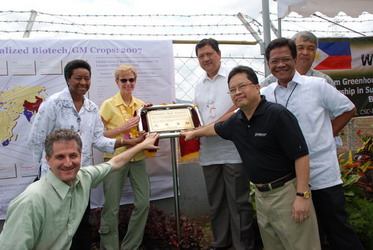
United States Ambassador to the Philippines Kristie Kenney visited the confined trial site of the public-sector developed biotech eggplant and papaya in the campus of the University of the Philippines Los Banos (UPLB). The unveiling of a site marker on the confined trial facility highlighted the activity on March 10, 2008 to commemorate the progress achieved in US-Philippine partnership on biotech crop R&D. The confined trials are being conducted to obtain horticultural data and perform breeding and line selection activities on the fruit and shoot borer resistant (FSBR) eggplant and the papaya ringspot virus resistant (PRSV-R) papaya being developed by the UPLB-Institute of Plant Breeding before these crops are advanced to multi-location trials.
During the program, Ambassador Kenney said that she was very happy that the contributions from the American people went a long way and helped in the research and development of the two biotech crops and added that she believes that the crops would significantly impact small farmers in the Philippines.
The activity was also attended by USAID (Philippines) Deputy Director Elzadia Washington, USAID Chief of Energy and Environment Office Daniel Moore and by representatives from USDA-Foreign Agricultural Service (FAS) as well as UPLB's partner institutions including the International Service for the Acquisition of Agri-biotech Applications (ISAAA), Agricultural Biotechnology Support II Project (ABSPII), Philippine Council for Agriculture, Forestry and Natural Resources Research and Development (PCARRD), Southeast Asian Regional Center for Graduate Study and Research in Agriculture (SEARCA), and various government regulatory agencies.
(L-R) USAID’s Daniel Moore and Elzadia Washington, Ambassador Kristie Kenney, UPLB Chancellor Luis Rey Velasco, PCARRD Executive Director Patricio Faylon, ISAAA Global Coordinator Randy Hautea and IPB Director Jose Hernandez Jr.
A Letter of Agreement was signed between the Chinese Society of Biotechnology (CSBT) and the International Service for the Acquisition of Agri-biotech Applications (ISAAA) for CSBT to become the latest member of ISAAA's network of Biotechnology Information Centers (BICs). China became the 18th member of the network that is composed of centers in Asia, Africa, Europe, and Latin America.
The China BIC based in Beijing will take an active role in crop biotechnology information dissemination and sharing initiatives, particularly in the translation of publications and information resources into Chinese. ISAAA's Crop Biotech Update, a weekly e-newsletter that synthesizes articles on crop biotech, is now available in Mandarin. Download the newsletter at http://www.isaaa.org/kc.
For more information about the China BIC, email CSBT's Deputy Secretary Hongxiang Zhang at zhanghx@mail.las.ac.cn.
Rice (Oryza sativa), one of the most important food crops, is drastically affected by drought, especially at the reproductive stage, thus, immensely affecting yield. Dissecting the important genes and the genomic regions influencing drought tolerance and yield will aid the breeders in understanding the genetic mechanisms underlying the plants' response to drought. This will then be the basis of the breeding strategies for the development of high yielding and drought tolerant varieties. The Research Centre of Biotechnology, Indonesian Institute of Sciences (LIPI) has successfully developed a genetically engineered rainfed lowland rice cultivar with drought tolerance. ”We have created the cultivar by overexpression of the genes encoding the transcription factors OsHOX” , said Prof. Dr. Umar A. Jenie, Head of LIPI. Furthermore, the cultivar is now being tested and is already in the early stage of a confined trial in a green house facility. This will be followed by environment and food safety testings as well as a multilocation field testing.
LIPI has also developed a yellow stem borer {S. incertulas (Walk)} -resistant rice variety. According to Prof. Jenie, the preliminary field testing result showed that the transgenic crops are not adversely affecting the environment ecology since there is no geneflow to another crop as well as to other insects or soil microbes. He also emphasized that all transgenic rice developed in Indonesia will be tested for its environmental and food safety.
For more information visit http://www.biotek.lipi.go.id/index.php?option=content&task=view&id=409 or http://www.biotek.lipi.go.id/ . Information on biotechnology research in Indonesia may be otained by emailing dewisuryani@biotrop.org.
Results of the annual "Consumer Attitude to Food" survey by the Food Standards Agency (FSA) revealed that only 20 percent of UK consumers consider GM ingredients in foods as a safety issue. This is significantly lower compared to the results of last year’s poll, wherein more than 25 percent of the respondents identified GMO as a safety concern. The amount of fat, salt and sugar in food are the top issues of concern identified by the respondents. This is followed by 32 percent citing the use of pesticide in crop cultivation and 28 percent identifying hormones in meat as safety issues.
For the complete survey results read http://www.food.gov.uk/multimedia/pdfs/cas2007ukreport.pdf. Visit http://www.coextra.eu/news/news1171.html for more information.
Genetically modified (GM) potatoes will not be cultivated in the EU this year, after the EU Commission delayed the approval of BASF’s Amflora. The transgenic potato was modified to produce pure amylopectin starch, which is suitable for paper, textile and adhesive production. It is intended for industrial use, and not for animal or human consumption.
The EU Commission has previously recommended the approval of the transgenic potato. This is after the European Food Safety Authority (EFSA) concluded that Amflora is identical to non-GM potatoes in regard to its effect on the environment. The recommendation was unable to find support from a qualified majority in the EU Council and by EU law, hence the responsibility for the approval was returned to the Commission.
For more information read http://www.gmo-compass.org/eng/news/349.docu.html
Scientists from the Wageningen University in the Netherlands have identified a gene that enables plants to produce higher biomass even in low-water and high salt conditions. The HARDY gene was identified by mutation screening in the model plant Arabidopsis. HARDY encodes a transcription factor, a protein that regulates expression of other genes. The scientists have also identified another gene-coding transcription factor, SHINE, that confers salinity tolerance to rice. The transcription factors facilitate the activation or inactivation of the plant’s entire drought and salinity tolerance mechanism.
When the HARDY gene was introduced to rice via genetic modification, the scientists obtained drought-tolerant lines that can perform in normal conditions with the same efficiency as non-GM rice. The fact that HARDY, from the dicot Arabidopsis, was successfully introduced to a monocot plant shows the broad applicability of the gene in a wide range of crop plants.
For more information visit http://www.pri.wur.nl/UK/newsagenda/news/Wageningen_scientist_discovers_genes_that_increase_yield_
on_marginal_soils.htm
A special report on the various elements of the food safety and nutritional assessment procedures for genetically modified (GM) plant derived food and feed is now complete and has been presented to the Advisory Forum on GMO risk assessment attended by regulatory risk assessment experts from the Member States, Norway and Sweden as well as the European Commission. The report discusses in particular the potential and limitations of animal feeding trials for the safety and nutritional testing of whole GM food and feed.
The full report is based on the general principles for the risk assessment of GM plants and derived food and feed as descibed in the EFSA Scientific Panel on Genetically Modified Organisms.
The report can be downloaded at: http://www.efsa.europa.eu/EFSA/efsa_locale-1178620753812_1178660555237.htm
A new finding by researchers from CIRAD (Centre Internationale de la Researche et Developpment) will facilitate sugarcane genomic work. This came about when CIRAD's researchers, who pioneered the exploitation of similar, simpler species such as rice and sorghum, recently confirmed the strong similarity of the sorghum and sugarcane genomes. The sorghum genome contains ten times fewer chromosomes than that of sugarcane and the complete sequence has been available since autumn 2007.
These results will make it easier to pinpoint useful agronomic and pest and disease resistance genes in the sugarcane genome, using the sorghum genomic sequence.
For details, please see: http://www.cirad.fr/en/actualite/communique.php?id=894
The transfer of herbicide resistance genes via pollen-mediated gene flow from genetically engineered (GE) crops to non-GE crops is often raised as a concern as it relates to co-existence of different agricultural cultivation systems and weed management. Hence, a literature search for worldwide studies on cross-fertilization in oilseed rape was done to identify the major factors that affect pollen-mediated gene flow.
Alexandra Hüsken and Antje Dietz-Pfeilstetter of the Federal Biological Research Centre for Agriculture and Forestry in Braunschweig discuss parameters affecting gene flow, that include shape, orientation, and size of pollen source and recipient field; isolation distance and border crops between pollen source and recipient field; and local environment and climatic conditions.
View a copy of the report at http://www.isb.vt.edu/news/2008/artspdf/mar0801.pdf
GM plants hold a promising alternative for production of pharmaceutical proteins. Compared to other systems, the use of GM plants offers advantages like the feasibility of low-cost and large-scale production and reduced risk of contamination with human pathogens. A wide array of plant-derived pharmaceutical proteins has been developed to treat diseases such as lymphoma, and cystic fibrosis.
Scientists from the Indian National Botanical Research Institute have developed transgenic tomato lines producing a functional human alpha-1-antitrypsin (AAT) protein. AAT is the most common serine protease inhibitor in the human plasma. Deficiency in AAT results to diseases like liver cancer, pulmonary emphysema, arthritis and dermatitis. Previous efforts to source AAT from transgenic bacteria, yeast cells and animals proved to be unsuccessful. The AAT derived from these hosts were either unstable, biologically inactive or mixed with immunogenic impurities.
The transgenes were found to be stably expressed in successive generations. AAT from the GM tomato lines exhibited high specific activity. On the average, 195 milligram of AAT can be obtained per kilogram of tomato leaves. The abstract of the article published by the journal Transgenic Research is available at http://www.springerlink.com/content/053336v077647j05/?p=afd6add86e7f4e06ad327a2c504f690a&pi=2
One of the major successes of plant biotechnology is the introduction of insect-resistance to important crops. Bt cotton and maize have been widely used in global agriculture and have led to significant reductions in pesticide usage. Not all pests, however, are efficiently targeted by the Bt toxins used at present. There is still a need to develop solutions for problems like Bt toxin resistance. A new review paper published by the journal Plant Physiology looks at the recent development to the basic Bt strategy and alternative methods to develop insect “proof” plants.
Plants expressing novel Bt toxins like Vip and Cry3Bb1 have been shown to be effective against lepidopteran larvae. Bt genes have also been expressed in the chloroplast genome, resulting to higher levels of toxin accumulation. Scientists are currently exploiting plant-defense proteins like lectins and alpha-amylase inhibitors to combat Bt resistant pests.
John Gatehouse, author of the review, enumerated novel approaches for engineering insect-resistant plants. These include:
The article can be accessed for free at http://www.plantphysiol.org/cgi/content/full/146/3/881
A group of researchers from India successfully developed transgenic strawberry lines tolerant to salt stress. The lines were modified to express the gene coding for the protein osmotin. Osmotin is induced by salt, water and low temperature stresses and has also been shown to possess anti-fungal activity. Scientists hypothesized that osmotin provides osmotolerance either by facilitating the compartmentalization of solutes or by being involved in the metabolic alterations during osmotic adjustment.
Genetic limitations, such as strawberry's polyploid nature and its high heterozygosity, complicate breeding efforts. Strawberry is an octaploid, meaning that it has eight sets of homologous chromosomes.
The transgenic lines were found to be stable in successive generations. Compared to their non-GM counterparts, the transgenic lines were found to contain enhanced levels of proline (amino acid involved in osmotic stress response), chlorophyll and total soluble proteins. The growth pattern of the GM lines showed no abnormality, except that their growth rate is slower than other plants.
The article published by the journal Plant Science is available at http://www.sciencedirect.com/science?_ob=ArticleURL&_udi=B6TBH-4RMW9P1-2&_user=6533655&_rdoc=1&
_fmt=&_orig=search&_sort=d&view=c&_acct=C000070094&_version=1&_urlVersion=0&
_userid=6533655&md5=c234f43efe5a0098f7519cd1b4fbbec0
Researchers and inspectors involved in GMO monitoring from Central and Eastern Europe, Western Balkans and Central Asia are invited to attend a workshop to be conducted by Co-Extra on March 26-28, 2008 in AgroBioInstitute, Sofia, Bulgaria. Co-Extra is an EU research program on co-existence and traceability of GMO. The workshop will provide an opportunity for international networking and the exchange of state-of-the-art knowledge for GM detection.
For more information, visit http://www.coextra.eu/news/news1173.html
Readers can now rate Crop Biotech Update articles. Just click on the “rate this article” link found on each article and fill up the required form. Visit the ISAAA website at http://www.isaaa.org to see more features.