CROP BIOTECH UPDATE
---------------------------------------------------------------------------
A weekly summary of world developments in agri-biotech for developing countries, produced by the Global Knowledge Center on Crop Biotechnology, International Service for the Acquisition of Agri-biotech Applications SEAsiaCenter (ISAAA)
---------------------------------------------------------------------------
February 26, 2010
In This Week’s Issue:
News
Global
• ISAAA's Annual Global Status Report Launched in Beijing, China
• No Technical Impediments to Biotech Rice
• New Initiative Will Harness Biotech to Improve Developing Countries' Breeding Efficiency
Africa
• Regional Climate Model for Crops in Africa
Americas
• Call for Comments on USDA Environmental Impact Statement Regarding RR Alfalfa
• Cloned Gene Being Used to Develop Aluminum Tolerant Crops
Asia and the Pacific
• Australian Scientists Developing Powdery Mildew-Resistant Barley Varieties
• Crop Bio-Breeding Industry Development Summit in Beijing
• India's Prime Minister Bats on GM Crops for Food Security
• GRDC and Grains Industry in Australia Develop Research Strategy
• Dow and Victorian Government Ink Biotech Agreement
• OGTR Receives Application for Limited Release of High-Yielding GM Canola
Europe
• GM Notifications in the EU
Research
• Researchers Decipher Aphid Genome
• NPR1-Expressing Cotton Plants Resist Fungal and Nematode Attacks
• Effects of Transgenic Rootstocks on Growth of Scion Cultivars in Apple
• Scientists Find the Female Hormone Progesterone in Plant
Announcements
• Fellowships for African Women
Document Reminders
• Nature as a Model for Ecological Intensification of Agriculture
----
NEWS
----
Global
ISAAA'S ANNUAL GLOBAL STATUS REPORT LAUNCHED IN BEIJING, CHINA
The Global Status of Commercialized Biotech/GM Crops for 2009 was recently launched in Beijing, China, which was dedicated to the late Nobel Peace Laureate Norman Borlaug and the first founding patron of the International Service for the Acquisition of Agri-biotech Applications (ISAAA). Dr. Clive James, author of the Report and ISAAA chair, highlighted the increase of 7% or 9 million hectares of biotech crops grown in 2009 over 2008. An increase of 14 million small and large farmers in 25 countries was also recorded to be planted in 134 million hectares. Costa Rica joined the 16 developing and 9 developed countries which are planting biotech crops. He stressed the importance of biotech crops in strategies to alleviate poverty, hunger and malnutrition.
The recent issuance of biosafety certicates for Bt rice and phytase maize in China was also emphasized and are expected to significantly impact the poor and hungry countries of Asia, Africa and Latin America, since rice is an important staple and corn, the primary feed for livestock and poultry. The events also highlighted presentations from Dr. Dafang Huang, a professor of the Chinese Academy of Agricultural Sciences on phytase maize and Dr. Ruifa Hu on Bt rice and Bt cotton. Farmer Mr. Zu Mao Tang shared his experience on planting Bt cotton.
The ISAAA Brief 41 Highlights, Executive Summary, Press Release and selected slides can be found at http://www.isaaa.org.
Recombinant DNA technology and methods for generating biotech rice are available thus assuring that there are no technical impediments to the widespread adoption of biotech rice by rice-growing countries. Dr. John Bennett, honorary professor of the School of Biological Sciences, University of Sydney, Australia, predicts that there will be further increases in the efficiency of biotech rice production with the introduction of (1) floral spray inoculation of Agrobacterium to avoid tissues culture; (2) homologous recombination to insert genes in a targeted rather than random manner, and (3) plastome transformation to permit alteration of key photosynthetic genes in the chloroplast.
In Biotech Rice-Present Status and Future Prospects, a special feature in Brief 41 on the Global Status of Commercialized Biotech/GM Crops 2009 published by the International Service for the Acquisition of Agri-biotech Applications, Bennett notes however, that several potential impediments arise from the regulation of biotech crops in the major rice-growing countries. He said that two major rice-growing countries, China and India, would benefit from more transparency in devising and costing the tests for food safety and environmental protection. A major challenge will be to enhance yield potential and yield stability and to give high priority to issues such as climate change.
A copy of Brief 41 can be purchased online at http://www.isaaa.org.
The Generation Challenge Program (GCP) of the Consultative Group on International Agricultural Research (CGIAR) and the International Crops Research Institute for the Semi-Arid Tropics (ICRISAT), in collaboration with the Bill & Melinda Gates Foundation have launched a new global initiative that aims to increase crop breeding efficiency in developing countries. Dubbed as the Molecular Breeding Platform (MBP), the initiative will be a one-stop shop for information, analytical tools and related services to design and efficiently conduct molecular-assisted breeding experiments.
"The five-year USD 12 Million project would revolutionize crop breeding and provide a level playing field allowing developing countries to take advantage of advanced plant breeding technology to meet the looming challenge in food security," says Dave Bergvinson, Program Officer of the Bill & Melinda Gates Foundation. Bergvinson noted that molecular breeding can succeed in the public sector, especially by partnering with the private sector, particularly with small- and medium-scale enterprises. He mentioned as an example Swarna-Sub-1, a flood-tolerant rice hybrid developed by marker assisted selection that has been successfully tested and adopted by the Bisauri Regional Progressive farmers Association in Uttar Pradesh under the supervision of Banaras Hindu University.
The MBP launch will be followed by a two-step launch program for a GCP Indo–Chinese research initiative to improve wheat yields.
The original story is available at http://www.icrisat.org/newsroom/news-releases/icrisat-pr-2010-media3.htm
Crop breeders in three East African countries - Kenya, Uganda, and Tanzania - will soon be able to analyze the impact of climate change on a wide variety of crops. The Michigan State University (MSU) in the U.S. has developed a customized regional climate model linked to crop growing and water models to help access crop yield.
The model can experiment with the impact of climate change, such as high temperature and water stress on a certain crop variety, thus saving time otherwise spent on field trials. "This will help speed up the agricultural research cycle," said Jennifer Olson, lead researcher and associate professor at MSU's College of Communication Arts and Sciences. While the model is still being perfected, it is expected to be demonstrated during a workshop in June.
View the full article at http://allafrica.com/stories/201002240894.html
A call for supporters for sound science and rational biotechnology regulation has been issued by the AgBioWorld Community on the USDA Environmental Impact Statement regarding the Roundup Ready Alfalfa. The move was triggered by the announcment by the US Department of Agriculture to extend the public comment period on its intent to deregulate, or grant commercial approval for Roundup Ready alfalfa. Comments should be focused on the following issues: herbicide tolerance traits are not unique, cross pollination would be very rare, there is no threat to organics, roundup ready alfalfa is already being grown successfully, biotech crops are safe, and biotech crops are an important tool for farmers. Comments can be submitted not later than March 3, 2010 at http://www.regulations.gov/search/Regs/home.html#submitComment?R=0900006480a7ba3f.
See the story at: http://www.agbioworld.org/newsletter_wm/index.php?caseid=archive&newsid=2952
Scientists at the U.S. Department of Agriculture Agricultural Research Service and Robert W. Holley Center for Agriculture and Health at Cornell University are developing sorghum varieties resistant to aluminum toxicity through molecular marker breeding. Aluminum toxicity occurs in highly acidic soils which are mostly found in developing countries of Africa, Asia and South America. The research group discovered the aluminum tolerance gene in a small number of sorghum varieties.
The gene encodes a novel membrane transporter protein in the root tip that mediates the release of citric acid into the soil upon exposure to the roots. Aluminum ions are bound with the citric acid preventing it from entering the roots. Genetic markers are currently being developed in order to efficiently introduce the aluminum tolerance gene into modern sorghum varieties. On going studies are also being conducted to improve maize tolerance to acidic soils.
For details, see the story at http://www.news.cornell.edu/stories/Feb10/aaasKochian.html
Plant breeders at the Australian Research Centre for Necrotrophic Fungal Pathogens (ACNFP) at Murdoch University are developing barley varieties with new resistance to the dreaded powdery mildew, the most damaging barley disease in Western Australia (WA). Caused by the fungus Blumeria graminis hordei (Bgh), the disease causes annual losses of $33 million in WA alone.
Researchers have discovered mlo, a gene which confers resistance to the disease. The gene, however, may cause a yield penalty and breeders resist its incorporation into new cultivars. The other sources of major resistance have a history of breaking down in a very few years. Now the ACNFP scientists are looking for alternative genes which will provide new varieties with a different form of resistance to powdery mildew. They are suggesting that farmers take an integrated approach including the use of resistant cultivars and fungicides.
"It is particularly important to find new ways of combating barley powdery mildew as growers are dangerously dependant on a single class of fungicides,"says Richard Oliver, leader of the study funded by the Grains Research and Development Corporation (GRDC).
Read http://fw.farmonline.com.au/news/state/grains-and-cropping/general/wa-project-will-help-combat-barley-powdery-mildew/1760459.aspx for more information.
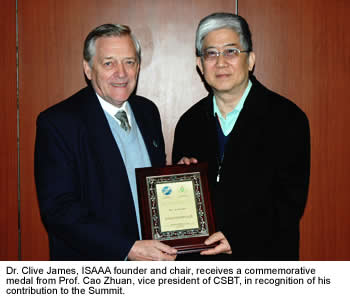
The Crop Bio-breeding Industry Development Summit cosponsored by the Chinese Society of Biotechnology (CSBT) and Chinese Society of Agricultural Biotechnology (CSABT) was held on February 25 in Beijing, China. More than 150 officers and experts from Ministry of Agriculture (MOA), Chinese Academy of Sciences (CAS), Chinese Academy of Agricultural Sciences ( CAAS), Peking University, China Agricultural University and relevant bio-corporations participated in this conference.
Dr. Clive James, founder and chair of the International Service for the Acquisition of Agri-biotech Applications (ISAAA), provided the global overview of biotech/GM crops in 2009 and talked about the current status, impact and future prospects of GM crops. He lauded the Chinese government's approval of GM rice and phytase corn and pointed out that the rapid development of biotechnology was a miracle for modern agricultural science and technology. Transgenic crop area has increased year by year and its adoption has brought enormous economic, social and ecological benefits. There will be a new wave of biotech crops development in 2009- 2015, Dr. James predicted.
Dr. Fan Yunliu, developer of phytase maize, and Dr. Zhang Qifa, developer of Bt rice, gave detailed reports on phytase maize and Bt rice. Both of them fully affirmed the biosafety of the two products. They expressed the hope that the media could be more objective and scientific in explaining GM issues and lead the public to a better understanding of the technology. This would provide a good environment for biotechnology development and continuously promote the healthy and sustainable development of bio-breeding industry.
For more information on crop biotech developments in China, contact Prof. Zhang Hongxiang of the China Biotechnology Information Center at zhanghx@mail.las.ac.cn
In the wake of a recent decision on Bt brinjal, the Prime Minister of India Dr. Manmohan Singh had a consultation on Bt brinjal with a group of senior Ministerial colleagues including Agriculture Minister Sharad Pawar, Science and Technology Minister Prithviraj Chavan, HRD Minister Kapil Sibal and Environment Minister Jairam Ramesh. The consultation underlined the importance of biotechnology in productivity and food security, called for private investment in biotech, a time-frame for a decision on Bt brinjal, and the establishment of the National Biotechnology Regulatory Authority. Mr Singh advised that The Genetic Engineering Approval Committee (GEAC), India's apex biotech/GM regulatory committee, will address the concerns and resolve all scientific issues relating to Bt brinjal.
Earlier this week, Agriculture Minister Mr. Sharad Pawar suggested in the letter to the Prime Minister that the ad hoc freeze on Bt Brinjal would set the clock back and demoralize Indian scientists. "The recent decision regarding Bt brinjal must not be seen as a setback to our efforts," he said in his address to the Conference of Vice Chancellors of Agricultural Universities. Science and Technology Minister Mr. Chavan and HRD Minister Mr. Sibal also echoed the voice in favor of Bt brinjal and supported Bt technology.
Visit the Press Information Bureau (PIB) for the article ‘PM holds consultation on the role of biotechnology in food security' available at http://pib.nic.in/release/release.asp?relid=58322 See also http://www.indianexpress.com/news/bt.-brinjal/583749/ For more information about biotech developments in India contact b.choudhary@cgiar.org and k.gaur@cgiar.org
Australia's Grains Research and Development Corporation (GRDC) and the Department of Agriculture and Food (DAFWA) are taking the lead in developing a national strategy for grains research, development and extension (RD&E). Other partners are state departments of agriculture, Commonwealth Scientific and Industrial Research Organization (CSIRO), universities, the Australian Government and growers. This was forwarded by GRDC managing director Peter Reading during the Agribusiness Crop Updates in Perth.
"The world of grains RD&E is evolving due to a number of factors – we need to understand those factors and determine where various organizations fit, making sure RD&E continues to function most effectively," Reading said. "The new national RD&E strategy recognizes the increasing importance of co-existence of the private and public grains sectors to ensure the development of the best technologies and establish the best possible pathways for new technologies to be adopted."
Read GRDC's press release at http://www.grdc.com.au/
Dow Agrosciences and the Victorian Government announced in a press release that they have signed a research and collaboration agreement in the field of biotechnology. "Agricultural biotechnology offers a tremendous potential to develop new varieties of crops that have drought tolerance, improved yields, disease tolerance and enriched human health benefits to list just some of the potential of this science," says Victoria's Premier John Brumby. Brumby notes that the agreement further builds on Victoria's biotechnology reputation and will assist Victorian farmers to meet the growing global demand for food. "Through this agreement, Dow will expand their work and therefore our research capability, specifically in the fields of biomass and yield enhancement, agronomic enhancement and modification of food, feed, fiber and oils characteristics in crops," says Brumby.
The press release is available at http://new.dpi.vic.gov.au/about-us/news-and-events/news/media-release-listing
The Department of Primary Industries Victoria (DPI Victoria) has submitted a license application to the Australian Office of the Gene Technology Regulator (OGTR) for the intentional release into the environment of transgenic canola lines. The canola lines have been genetically modified for enhanced yield and delayed leaf senescence. They contain the isopentyl transferase (ipt) gene from the soil bacterium Agrobacterium tumefaciens as well as the antibiotic resistance marker gene hph from E. coli.
If approved, the release will take place at two sites in the local government areas of Horsham and Southern Grampians, Victoria on a maximum area of 0.8 ha per year between May 2010 and May 2012. DPI Victoria has proposed a number of control measures to restrict the spread and persistence of the GM plants and their introduced genetic material, including: locating the trial sites at least 50 m away from natural waterways, surrounding the GM canola with a 15 m pollen trap of non-GM canola and a 50 m monitoring zone that is free of canola and related species, locating the trial sites at least 400 m away from any Brassica crop and destroying all GM plant material not required for testing or future trials.
The OGTR is preparing a Risk Assessment and Risk Management Plan (RARMP) for the proposed release. The office says it will release the RARMP on or before June 2010 for public comment.
Visit http://www.ogtr.gov.au/internet/ogtr/publishing.nsf/Content/dir103 for more information.
European Commission's Joint Research Centre has posted notifications on the deliberate release into the environment of genetically modified (GM) crops for non-commercial use in Europe. The latest notifications include:
For details of the notifications visit http://gmoinfo.jrc.ec.europa.eu/gmp_browse.aspx
Aphids are common pests of crops and ornamental plants. They feed exclusively on sugar-rich plant phloem sap by inserting their mouthparts into sieve elements, the primary food conduits of plants. Aphids cost farmers hundreds of millions of dollars annually by inflicting damage both through the direct effects of feeding and by vectoring debilitating plant viruses. In addition to their importance as agricultural pests, aphids are also important biological models for studies of insect-plant interactions, symbiosis, virus vectoring, and the developmental causes of extreme phenotypic plasticity.
An international consortium has published the whole genome sequence of the pea aphid Acyrthosiphon pisum. Reporting in the journal PLoS Biology, members of the International Aphid Genomics Consortium said they found extensive gene duplication in more than 2000 gene families as well as loss of evolutionarily conserved genes including genes involved in the IMD immune pathway, selenoprotein utilization, purine salvage, and the entire urea cycle. The 464 Mb aphid genome contains all genes required for epigenetic regulation by methylation. The researchers also found that the genes encoding the synthesis of a number of essential amino acids are distributed between the genomes of the pea aphid and its symbiont, Buchnera aphid cola.
"We found that the interaction of the pea aphid with its bacterial symbiont is far more intimate than anyone had previously envisioned," says Alex Wilson, professor at the University of Miami and member of the research team. "We hypothesize, based on the genome sequence that they each compensate for the evolutionary loss of genes by shuffling essential metabolic products between them. Gene loss between the two partners is so extensive that neither one can live without the other."
The paper is available at http://dx.doi.org/10.1371/journal.pbio.1000313
By introducing the Non-expressor of Pathogenesis-Related genes-1 (NPR1) from Arabidopsis thaliana, researchers at the Texas A&M University and the United States Department of Agriculture have developed cotton strains with resistance against various fungal pathogens and reniform nematode. NPR1 plays a critical role in plant systemic acquired resistance (SAR), a long lasting defense response that is induced in plants by localized infection and provides subsequent protection against a broad spectrum of pathogens.
Cotton plants expressing the gene were found to be resistant to four important fungal diseases of cotton caused by Verticillium dahliae, Fusarium oxysporum f. sp. vasinfectum, Rhizoctonia solani, and Alternaria alternata as well as to the nematode Rotylenchulus reniformis. Reporting in the journal Transgenic Research, the scientists said that analysis of defense-related, biochemical and molecular responses suggest that when challenged with pathogens or certain systemic acquired resistance-inducing chemicals, the transgenic lines respond to a greater degree compared to the wild-type plants. They also found that the basal activities of the defense-related genes and enzymes in uninduced transformants were no different than those in their non-transgenic counterparts.
Download the paper at http://dx.doi.org/10.1007/s11248-010-9374-9
Although cultivation of GM crops has been steadily increasing, the commercial cultivation of GM fruit tree is still very limited and reports of field trials on GM fruit trees are rare. So far, the only GM tree species that are commercially cultivated are GM poplar with insect resistance grown in China and GM papaya with virus resistance grown in USA and China.
Researchers from the Swedish University of Agricultural Sciences are investigating the effects of transgenic apple rootstocks on growth, flowering and fruit quality of non-transgenic scion cultivars grafted onto these rootstocks. The rootstocks express the rolB gene, a well documented rooting related gene and has been proved to stimulate rooting in different plant species when over expressed. In apple production, dwarfing rootstocks are commonly used for achieving high production efficiency.
The researchers, reporting in the journal Transgenic Research, found that all rolB transgenic rootstocks significantly reduced vegetative growth including tree height regardless of scion cultivar, compared with the non-transgenic rootstocks. Flowering and fruiting were also decreased for cultivars grown on the transgenic rootstocks in most cases, but the fruit quality was not clearly affected by the transgenic rootstocks. The use of GM rootstocks in combination with non-transgenic scion cultivars may circumvent the food safety issue if the transgenes or their products are not present in scion fruits.
The original paper is available at http://dx.doi,.org/10.1007/s11248-010-9370-0
Researchers at the University of Illinois in Chicago are reporting for the first time the discovery of the female sex hormone progesterone in a plant. Guido F. Pauli and colleagues said they have found the steroid hormone in Juglans regia (common walnut). The discovery came as a surprise since scientists thought that only animals could make progesterone. A steroid hormone, secreted by the ovaries, progesterone prepares the uterus for pregnancy and maintains pregnancy. A synthetic version, progestin, is used in birth control pills and other medications.
"The significance of the unequivocal identification of progesterone cannot be overstated," Pauli and colleagues wrote in the article published by the Journal of Natural Products. "While the biological role of progesterone has been extensively studied in mammals, the reason for its presence in plants is less apparent." They speculate that the hormone, like other steroid hormones, might be an ancient bioregulator that evolved billions of years ago, before the appearance of modern plants and animals. The new discovery may change scientific understanding of the evolution and function of progesterone in living things.
The original paper is available for download at http://dx.doi.org/10.1021/np9007415
African Women in Agricultural Research and Development (AWARD), a project of the CGIAR Gender and Diversity Program, is accepting applications for its 2010 fellowships. The two-year fellowships aim to fast-track the careers of African women scientists and professionals involved in pro-poor agricultural research and development.
Deadline for applications is on March 22, 2010. Details and application forms can be downloaded at http://www.genderdiversity.cgiar.org/resource/award.asp
The French Centre for Agricultural Research and Development (CIRAD) has recently published a report on La nature comme modèle, pour une intensification écologique de l'agriculture or Nature as a model for ecological intensification of agriculture. The 15-page brochure deals on how to build sustainable farming systems capable of feeding nine billion people by 2050 and providing them with energy and biomaterials, while preseving the environment and resources. Specifically, the discussion revolves around nature as a model, the humid tropical climate, the dry tropical climate, the Mediterranean climate, and agricultural research and innovation.
The brochure is downloadable at http://www.cirad.fr/en/news/all-news-items/articles/2010/ca-vient-de-sortir/la-nature-comme-modele