CROP BIOTECH UPDATE
---------------------------------------------------------------------------
A weekly summary of world developments in agri-biotech for developing countries, produced by the Global Knowledge Center on Crop Biotechnology, International Service for the Acquisition of Agri-biotech Applications SEAsiaCenter (ISAAA)
---------------------------------------------------------------------------
February 20, 2009
In This Week’s Issue:
News
Global
• Biosafety Decisions and Perceived Commercial Risks
Africa
• Policy Issues in Adoption of Bt Cotton in West Africa
• AATF Appoints Executive Director
Americas
• Deciphering the Functions of 41,000 Rice Genes
• ARS Study: More Fertilizer Doesn’t Always Mean More Yield
Asia and the Pacific
• Limited Release of GM Sugarcane in Australia
• Bangladesh Ag Minister Supports GM Crops for Food Security
• Thailand's NSTDA to Boost Industries
• White Paper: Status of Biotech Research and Development in Thailand
• Thai Scientists Map Algae Genome
• Potential for Cassava in Thailand
• Philippines Approves Low Level Presence Policy
• IRRI and NUS Partner for Rice Research
• Dow, Syngenta in Collaboration with Chinese Rice Research Institutes
Europe
• EU Experts Fail to Agree on French, Greek GM Ban
• EU Court: GM Crop Locations Must be Made Public
• Deliberate Release of GM Plants in the EU
• Bayer Partners with IPK for Biotech Canola Research
Research
• Scientists Pinpoint Gene that Keeps Plant Cells 'In Touch'
• Simple Genetic Mechanism Could Drive Species Separation
Announcements
• GM Crops Coexistence Conference in Australia
----
NEWS
----
Global
BIOSAFETY DECISIONS AND PERCEIVED COMMERCIAL RISKS
What are the effects of genetically modified (GM)-free private standards set up by food companies on biotechnology and biosafety policy decisions in food-exporting developing countries? Food companies are indirectly influential via their local traders who face the possibility of exclusion if they do not comply with the standards. Organic producers and anti-GM organizations spread perceptions of commercial risks that are not always justified. These findings were observed in a study by the International Food Policy Research Institute on "Biosafety Decisions and Perceived Commercial Risks: The Role of GM-Free Private Standards" by Guillaume Gruère and Debdatta Sengupta.
Among the misleading presumptions by interest groups that cause concern are the infeasibility of non-GM product segregation and the lack of alternative buyers. Risk-averse behaviors related to perceived market power also cause unfounded export concerns into biosafety or biotechnology policy decisions. The study forwards a framework to help decision makers when they face pressures to reject GM crop testing, application, consumption, or use for fear of alleged export losses.
Download the full paper at http://www.ifpri.org/pubs/dp/IFPRIDP00847.pdf
A socio-economic impact assessment of the potential adoption of insect resistant cotton in West Africa forwards two distinct recommendations. One is that governments in West Africa need to identify and promote appropriate incentives to choose the best from technology alternatives. The second is the need to identify and mitigate policy and institutional constraints that may limit the proper technology deployment in West Africa. These recommendations were forwarded by Jose Falck-Zepeda and colleagues in "Policy and Institutional Factors and the Distribution of Economic Benefits and Risk from the Adoption of Insect Resistant (Bt) Cotton in West Africa."
The study used an economic surplus model to consider risk and parameter uncertainty. Changes in parameters such as technology fees, regulatory lags, and adoption patterns are important in shaping response to and distribution of Bt cotton technology.
Email Jose Zepeda at j.falck-zepeda@cgiar.org or read the article in the Asian Biotechnology and Development Review, Volume 11, No. 1 issue.
A new Executive Director of the African Agricultural Technology Foundation was appointed recently to take over Professor Jennifer Thomson. Dr. Daniel Fungai Mataruka, the newly appointed Executive Director is an agronomist and business development strategist, and carries valuable management and strategic leadership experiences from his many years of association with Tongaat Hulett Starch, a leading large scale agro-business company in southern Africa.
For details see the press release at http://www.aatf-africa.org/newsdetail.php?newsid=126. For news about biotechnology in Africa, contact Daniel Otunge of ISAAA East Africa at d.otunge@isaaa.org
Rice, with its diminutive genome, has been used as a model crop for research of other cereals. The rice genome, around 420 megabases long, is one-sixth the size of the maize genome and 40 times smaller than that of wheat. Although the complete rice genome sequence was finished in 2004, research on the function of individual rice genes lags behind the same studies in other cereal crops.
Pamela Ronald and colleagues from the University of California-Davis and Pohang University of Science and Technology in South Korea have catalogued the different techniques available to determine the function of genes in rice. These tools, which will help scientists discover the function of the estimated 41,000 rice genes, include: rice lines that are lacking function of one or more genes (gene-indexed mutations), methods for assaying the expression of genes in different environments, and databases to catalog rice gene function (whole-genome arrays and genome-tilling arrays).
These tools can also be used in studying other cereals as well as bioenergy crops, such as switchgrass. The study was funded by USDA's Cooperative State Research, Education, and Extension Service (CSREES).
For more information, visit http://www.csrees.usda.gov/ The paper published by Nature Review Genetics is available at http://dx.doi.org/10.1038/nrg2286
A ten-year study conducted by researchers at the US Department of Agriculture's Agricultural Research Service (ARS) and Colorado State University revealed that more fertilizer doesn't always mean more yield. The researchers, led by Ardell Halvorson, evaluated and compared potential management strategies for reducing nitrogen and nitrate nitrogen levels in soil and groundwater.
Halvorson and his colleagues planted onion in a region in Colorado that has high levels of nitrate nitrogen in the fields and groundwater. They found that onions used only about 12 to 15 percent of the fertilizer nitrogen applied to the crop. The next year, the scientists planted corn on the same land. It turns out that corn is a very good nitrogen scavenger. They found that it recovered about 24 percent of the fertilizer nitrogen that had been applied to the onion crop the year before.
Unfertilized corn grown on the field yielded around 250 bushels per acre. By comparison, a plot supplied with 250 pounds of nitrogen per acre yielded about 260 bushels. That's a small increase that required a significantly higher investment of time and money.
The article is available at http://www.ars.usda.gov/is/AR/archive/feb09/nitrogen0209.htm
BSES Limited has submitted an application to the Australian Office of the Gene Technology Regulator (OGTR) for the limited and controlled release of GM sugarcane lines. The lines have been genetically modified for nitrogen use efficiency, improved drought tolerance, enhanced accumulation of sucrose and other fermentable sugars and altered plant growth. The release is proposed to take place at six sites in Queensland on a maximum area of 21 hectares per year over fifteen years from 2009 to 2024. If approved, BSES is bound to adopt certain measures to restrict the dissemination of GM plant materials, such as surrounding the trial site with a pollen trap and postharvest monitoring of fields.
BSES has proposed the release of 24 transgenic sugarcane lines expressing the OsDREB1 and ZmDof1 genes from rice for increased tolerance to low water conditions and improved nitrogen use efficiency. In addition, some lines contain genes from barley and beans that are expected to alter plant architecture. No plant materials from the GM sugarcane would be used for human food or animal feed.
For more information, visit http://www.ogtr.gov.au/ The application summary is available at http://www.ogtr.gov.au/internet/ogtr/publishing.nsf/Content/dir095
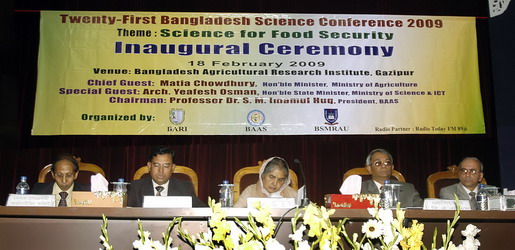
A three -day Conference on Science and Food Security for 600 participants of the Bangladesh Association for the Advancement of Science was recently concluded in Gazipur, Bangladesh. In her inaugural speech, Agriculture Minister of Bangladesh Matia Choudhury urged scientists to develop through biotechnology rice varieties and other major crops with important traits such as tolerance to waterlogging, flood, drought and salinity, as well as resistance to insect pests and diseases. She also expressed her pessimism towards food production through organic farming since this will not realistically produce enough food for the country's population in the midst of diminishing crop land. Dr. Md. Harun-Ur-Rashid, Director General of Bangladesh Agricultural Institute and Executive Chairman of Bangladesh Agricultural Research Council on the other hand, emphasized the use of biotechnological approaches for food security and nutritionally balanced food supply.
For details of the conference and for information on biotechnology in Bangladesh please contact Prof. K. M .Nasiruddin of Bangladesh Biotechnology Information Center at nasirbiotech@yahoo.com
The National Science and Technology Development Agency (NSTDA) in Thailand plans to enhance industries by providing research and development support as well as technology transfer, human resource development, and operation management. NSTDA President Sakarindr Bhumiratana says that it will also increase the potential benefits of science and technology by setting up a technology network to create competitiveness and increase productivity.
NSTDA will adopt a cluster approach to enhance research and development in six industry groups: textiles and chemicals, food and agriculture, medical and public healthcare, software, microchips and microelectronics, automotive and transportation, and energy and environment.
More information is available at http://www.safetybio.agri.kps.ku.ac.th/index.php?option=com_content&task=view&id=4769&Itemid=42 or http://www.nationmultimedia.com/worldhotnews/30094254/Agency-plans-big-spending-to-boost-Thai-industry
The challenges facing biotechnology in the years ahead are not just scientific and technological but also relate to matters of public policy and public perception. Thailand has put much effort into ensuring that biotechnology is practiced within the country in a sustainable and safe manner. Through consultations with international partners, it has put in place the required infrastructure and capacity to support a sound, science based policy and regulatory framework. Decisions made by the relevant authorities concerning the use of modern biotechnology are being taken with full public participation and scrutiny.
Read the white paper on key issues and information relating to Thailand' s readiness for biotechnology at http://safetybio.agri.kps.ku.ac.th/images/stories/pdf/White_Paper.pdf or http://home.biotec.or.th/NewsCenter/my_documents/my_files/22C14_Thailand_White_Paper.pdf
Thai scientists and researchers have become the first in the world to successfully sequence the genome of a water organism called Spirulina platensis. BIOTEC director Kamyawim Kirtikara said the cracking of the genetic code of the blue-green algae aims to help improve productivity in agriculture, shrimp farming, fodder production, nutrition and healthcare, crop improvement and animal husbandry. Importantly, it will help improve the domestic breeding stock of black tiger shrimp. The project began three years ago as a collaborative effort involving 18 researchers and six scientists from Biotec, King Mongkut's University of Technology Thonburi, Chiang Mai University and Kasetsart University. The genetic sequencing of S. platensis is now more than 90 per cent complete and is expected to be finished early next year.
More information is available at http://www.safetybio.agri.kps.ku.ac.th/index.php?option=com_content&task=view&id=4768&Itemid=42 or http://www.nationmultimedia.com/worldhotnews/30087994/Thai-scientists-map-algae-genome
Cassava roots are utilized for making dry chips, pellets, native starch, modified starch, MSG (monosodium glutamate), glucose, fructose, sorbitol, sago, and citric acid which are used in the food, beverage, feed, paper, textile, and plywood industries. In addition, they are used as the major raw material for the production of bioethanol, an alternative biofuel to be blended with petroleum gasoline.
Currently in Thailand, six factories are licensed to produce fuel ethanol from cassava and have an estimated total capacity of 2.120 million liters per day. The National Ethanol Committee has given permission to another nine factories to produce fuel ethanol from cassava increasing maximum capacity of 3.350 million liters of ethanol per day. This will cause an enormous demand of cassava up to 20,000 tonnes of roots per day or 7.2 million tonnes of roots per annum.
For the full article visit http://safetybio.agri.kps.ku.ac.th/images/stories/pdf/casava[1].pdf
Philippine Department of Agriculture (DA) Secretary Arthur C. Yap signed Administrative Order No. 1 (AO No. 1) Series of 2009 which adopts Annex 3 to the Codex Plant Guideline, "Food Safety Assessment in Situations of Low-Level Presence of Recombinant-DNA Plant Material in Food". AO No. 1 directs concerned DA offices to clarify issues and formulate guidelines for implementation. Lastly, AO No. 1 orders an institutional capability program for the DA's regulatory agencies to enhance its technical capabilities to undertake the appropriate regulatory action. AO No. 1 takes effect 30 days after its publication in a newspaper of national circulation.
See the report at http://www.fas.usda.gov/gainfiles/200902/146327239.pdf
The International Rice Research Institute (IRRI) and the National University of Singapore (NUS) signed a memorandum of understanding (MoU) to promote joint research and scientific exchange between both organizations as they work together to help address the pressing global challenge of food security. IRRI and NUS will collaborate on developing rice varieties with increased productivity, enhanced nutritional value and tolerance to harsh environments.
Barry Halliwell, NUS deputy president said: "We are excited to work with IRRI to contribute our research expertise to help boost regional rice production. NUS' approach has been to address challenges facing Singapore by engaging in high impact research, and securing our food supply is one of our priorities. This is especially so as Singapore relies on our neighboring countries to produce food."
Read the media release is available at http://beta.irri.org/index.php?option=com_content&task=view&id=576&Itemid=414
Indianapolis-based Dow AgroSciences LLC announced that it has signed a research partnership with the China Rice Research Institute (CRRI) to study new technologies in rice production. The partnership will bring together Dow's platform of traits and technologies and CRRI's leading rice germplasm. In a press release, Dow vice president Daniel R. Kittle said that the collaboration will lead to improvements in one of the world's most important food crops and help address the needs of our growing global population.
On a separate note, Syngenta is collaborating with the Anhui Rice Research Institute (ARRI) of China's Anhui Academy of Agricultural Sciences. The partnership will focus on drought tolerance and nitrogen utilization optimization in key crops such as corn and soybean using rice as a model crop. Syngenta said that the agreement is part of the company's effort to work closely with Chinese academics.
The media releases are available at http://www.dowagro.com/newsroom/corporatenews/2009/20090217a.htm and http://www.syngenta.com/en/media/mediareleases/en_090210.html
European Union (EU) experts failed to reach a decision on whether France and Greece should be forced to lift their ban on growing Mon810, Monsanto's insect-resistant maize and the only genetically modified crop approved for cultivation in the continent. In early 2008, the French government issued a nationwide ban on the GM maize, invoking the safeguard clause, because of 'serious doubts' as to its safety. The European Commission put forward a proposal saying that France and Greece should lift their ban after the European Food Safety Authority (EFSA), EU's risk assessment body for food and feed safety, rejected the countries' claim that the GM maize poses risk to human and animal health.
Nine EU member states voted for the ban to be lifted whereas 16 opposed or abstained. If in the coming months the EU nations failed to reach a decision, the Commission will give the final say.
The Commission will vote again next month to decide on whether Austria and Hungary should lift a similar GM ban.
Read http://www.nature.com/news/2009/090217/full/457946a.html for more information
The EU's highest court, the European Court of Justice in Luxembourg, has ruled that EU governments have no right to conceal the location of fields where genetically modified crops have been released. Scientists fear that such information could provoke public disorder and may lead to the destruction of GM crops. But the court stated that "information relating to the location of the release can in no case be kept confidential," and public-order considerations "cannot constitute reasons capable of restricting access to the information."
In 2004, Pierre Azelvandre asked the local authorities in his home province of Alsace, eastern France, to tell him where GM plants had been released in his area. The authorities refused, saying that divulging such information could place farmers at risk from GMO opponents. Azelvandre filed a case to a French court, which asked the Court of Justice for a ruling.
Read the press release at http://www.earthtimes.org/articles/show/256120,eu-states-cannot-cover-up-gmo-sites-court-rules.html and http://curia.europa.eu/en/actu/communiques/cp09/aff/cp090016en.pdf
Several genetically modified crops are scheduled for non-commercial release in the European Union. These include:
Environmental risk assessments have indicated that the releases pose negligible risk to human health and safety or to the environment. The applicants are bound to adopt certain measures to prevent the escape of GM plant materials.
Visit http://gmoinfo.jrc.ec.europa.eu/ for the latest GMO notification in Europe.
Bayer CropScience announced that it is teaming up with Germany-based Leibniz Institute of Plant Genetics and Crop Plant Research (IPK) to develop genetically modified, high-yielding canola varieties. Canola is an important source of oil used in the food industry and as a raw material for manufacturing biodiesel. The oil content of conventional canola is around 45 percent. Bayer and IPK believe that oil content in canola can be increased by means of plant biotechnology. Michiel van Lookeren Campagne, head of BioScience Research at Bayer CropScience, commented that the collaboration will open new opportunities for the company's customers. Bayer said that it plans to "further grow its business in canola seed and improved traits, for example, by expanding regionally into new geographical markets and by boosting research."
Read the press release at http://www.bayercropscience.com/BCSWeb/CropProtection.nsf/id/EN_20090216?open&l=EN&ccm=500020
Cell to cell communication is important in plant cells, especially during development. Plant cells communicate via microscopic channels embedded in their cell walls. These channels, called plasmodesmata, mediate the transport of metabolites and proteins. In meristems, or plant stem cells, plasmodesmata serve as the channels where genetic instructions for growth pass through. These microscopic pores are regulated by development and environmental signals. But little is known about the genes and molecular pathways that respond to these signals. Scientists at the Cold Spring Harbor Laboratory in New York, led by David Jackson, pinpointed the gene responsible for keeping plasmodesmata open.
Although restricting inter-cellular traffic can be beneficial at times, this can be detrimental to meristems. Environmental signals such as stress trigger the production of callose, a substance that blocks plasmodesmata. Oxygen free radicals can trigger the production of callose. The team identified a gene called Gat1 (gate-one) that encodes thioredoxin-m3, an enzyme that slows down and prevents the production of reactive oxygen species. Cells with defective Gat1 accumulate high levels of free radicals and other toxic ions. Seeds in which this gene failed to work were found by the scientists to give rise to seedlings that barely survived more than two weeks.
Jackson and colleagues also discovered that increasing the expression of Gat1 in mature leaves led to a delay in senescence and flowering. Controlling senescence may lead to the development of plants that last longer or flowers that stay fresh longer.
Read http://www.cshl.edu/public/releases/09_gat1.html for the complete article. The paper published by PNAS is available at http://www.pnas.org/content/early/2009/02/12/0808717106.full.pdf+html
Nature has its ways of keeping species separate. Dogs cannot breed with cats to produce cat-dogs. Although tigers and lions can, ligers and other hybrids such as mule cannot produce offsprings. The genetic basis of species separation has long puzzled scientists. A team of researchers at the French National Institute for Agricultural Research (INRA) in Versailles and University of Nottingham in the UK think that they may have unlocked some of the secrets behind reproductive barriers that isolate one species from another.
The researchers sampled Arabidopsis thaliana strains, the laboratory mouse of the plant world, from Colombia and the Cape Verde Islands. They noted that offspring of the cross between these strains did not fully obey Mendel's classic laws of heredity. Individuals with a specific genetic combination from the two parents were missing.
The team linked the incompatibility between the two strains to a single gene. This gene encodes histidinol phosphate aminotransferase (HPA) an enzyme necessary for the production of the amino acid histidine. HPA is found in chromosome 1 in the Island strain and in chromosomes 1 and 5 in the Colombian strain. The HPA gene became inactivated in chromosome 1 in the Colombian strain. And therefore HPA is carried in two separate chromosomes. Embryos that inherited chromosome 1 from the Colombian strain and chromosome 5 in the Island strain therefore carry no functional HPA gene. This illustrates how evolution of a single gene can rapidly lead to differences within a species.
The paper published by Science is available at http://dx.doi.org/10.1126/science.1165917 For more information, read http://www.international.inra.fr/press/simple_genetic_mechanism_may_be_behind_the_origin_of_species
The 2009 Genetically Modified Crops Coexistence Conference (GMCC'09) will be held in Melbourne, Australia on 10 – 12 November 2009. The conference will cover key issues on coexistence between GM and non-GM agricultural supply chains ranging from production level to the market place. Topics include: gene flow in agricultural systems, traceability and control of coexistence and legal and policy issues of coexistence frameworks among others.
More information is available at http://www.gmcc-09.com/