CROP BIOTECH UPDATE
---------------------------------------------------------------------------
A weekly summary of world developments in agri-biotech for developing countries, produced by the Global Knowledge Center on Crop Biotechnology, International Service for the Acquisition of Agri-biotech Applications SEAsiaCenter (ISAAA)
---------------------------------------------------------------------------
December 14, 2007
In This Week’s Issue:
News
Global
• Standards Needed for Detecting Biotech-Derived Crops
• Organic Agriculture Can Help in the Fight Against Hunger, But....
• Climate Change and Food Security
Americas
• Gene Flow from GM Crops Less Likely to Harm the Environment
• Study Points the Pros and Cons of Organic Tomato Farming
• Purple Bacteria to Combat Crop Pests
• First Moss Genome Decoded
Asia and the Pacific
• LTU and Victoria to Build Bioscience Center
• Australia to Plant GM Rapeseed in 2008
• IFAD Supports Biofuels Research Project Led by ICRISAT
• The Power of Three: Wheat Trigenomic Chromosome
• Reorienting Agric Research in India through Biotech
• Dupont and China to Work on Agri-biotech
Europe
• Consequences of EU Regulation
• Review Says GM Crop Ban in Europe Is Counterproductive
• Alliance to Develop Winter Oilseed Rape Products for Europe
• How Environment Turns the Plant Biological Clock
Research
• GM Plants that Produce Higher Biomass
• GM Grapevine with Increased Resveratrol
• Its a Matter of Size: Intracellular Control of Plant Organ SIze
Document Reminders
• FAO Consultation Report on Biosafety
----
NEWS
----
Global
STANDARDS NEEDED FOR DETECTING BIOTECH-DERIVED CROPS
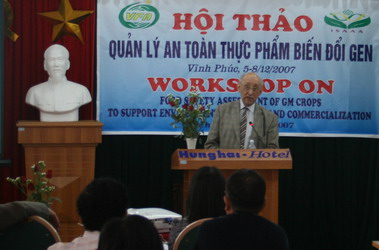
Testing to detect biotech-derived crops needs to be effective, consistent, and predictable along the supply chain to satisfy commercial intellectual property and or/traceability requirements. Test method developers need to validate methods using internationally acceptable approaches, to demonstrate they are "fit for purpose" and transferable to practical testing environments. These points were stressed by Dr. Ray Shillito, External Technical Support Manager - America, Molecular and Biochemical Analytical Services of Bayer CropScience, during a food safety assessment workshop in Dai Lai, Vinh Phuc Province, Vietnam.
in his talk on "Analytical techniques for detection of biotechnology-derived crops" Shillito emphasized the need for standards and standardization; as well as for appropriate testing thresholds based on the sampling and test precision needs. Shillito is chairman of the working group of the International Life Sciences Institute Food Biotechnology Committee that prepared the publication "Sampling and detection methods for products of modern agricultural biotechnology in NAFTA countries."
The food safety workshop for experts from the Ministries of Health and Agriculture was organized by the Vietnam Food Administration and the International Service for the Acquisition of Agri-biotech Applications.
Dr. Ray Shillito can be contacted at his email address: ray.shillito@bayercropscience.com.
The Food and Agriculture Organization (FAO) of the United Nations has no reasons to believe that organic farming can substitute for conventional farming systems in assuring the World’s food security, said FAO director general, Jacques Diouf. Diouf made the statement after press releases and media reports suggesting that FAO endorses organic agriculture (OA) as the solution to world hunger.
Diouf pointed out that OA can help in the battle against hunger, as organic farming represents a growing source of income for many countries. But chemical inputs, especially fertilizers, are needed to boost agricultural production in developing countries particularly in Sub-Saharan Africa. The recent World Development Report by the World Bank stressed that low fertilizer use is one of the key constraints in African agriculture. Diouf cited Malawi as an example. The country, which has been a recipient of food aids for years, has boosted its maize production after adopting a policy of providing small scale farmers with seeds and fertilizers. He also noted that higher productivity with lower inputs can be obtained with systems like Integrated Pest Management and Conservation Agriculture.
The FAO director general concluded that there is no one solution to the problem of world hunger. He enumerated the key factors that will help solve the problem. These include: knowledge and capacity building, increased private and public investments and right policies and technologies.
Read the FAO press release at http://www.fao.org/newsroom/en/news/2007/1000726/index.html
One of the great challenges of the 21st century will be to increase the global food and timber supply to accommodate a world growing to 10 billion or more people while undergoing climate change. Meeting the challenges brought about by climate change will require cooperation between different countries and institutions. The impacts of climate change in agriculture and forestry including its implications to food security is highlighted in a series of review papers published by the US Proceedings of the National Academy of Science (PNAS).
Within the developing world, adverse effects of climate change will fall disproportionately on the poor. It will most likely increase the dependency of developing countries on imports, especially in sub-Saharan Africa and South Asia. These regions will require help from the international community. The regions will benefit from: freer trade, which can help improve access to international supplies, investments in communication and transportation infrastructure, irrigation and promotion of sustainable agricultural practices. The reviews also enumerated possible strategies for adapting food and forestry production to climate change.
The Climate Change and Food Security Special Feature of PNAS is available at http://www.pnas.org/current.shtml#SF_RESEARCH_ARTICLES
Gene flow, the movement of genes from one population to another, has always occurred naturally. However, it has attracted much attention during the past decades, particularly in the advent of modern crop biotechnology. Commercialization of transgenic crops increased the interest of understanding and managing gene flow. A new issue paper published by the Council for Agricultural Science and Technology (CAST) offers insights regarding the gene flow potential and economic implications of transgenic crops.
The paper addresses several issues ascribed to gene flow. These include: gene transfer ramifications of traits introduced to GM crops, adventitious presence and its relation to gene transfer, containment approaches for the mitigation of gene flow and regulatory and risk assessment mechanisms for biotech crops.
Task Force Chair David Gealy of the USDA Agricultural Research Service pointed out that genes introduced to GM plants will have little to no effects on the dynamics of gene flow, especially outside agricultural fields. He also noted that pre-commercialization procedures that take into account the specific trait being introduced will help minimize the impacts of gene flow.
The press release, as well as the link to the paper entitled Implications of Gene Flow in the Scale-up and Commercial Use of Biotechnology-derived Crops: Economic and Policy Considerations are available at the CAST website http://www.cast-science.org/
Results of the study by a team of researchers from the University of California Davis showed that organically produced tomatoes were higher in sugars and other soluble solids, consistency and acidity, desirable traits in tomato processing. Organic tomatoes, however, were found to have lower vitamin C, red pigments and phenolic compounds. The study has taken into account difference in fruit properties that may be brought about by genetics, soil nutrients, irrigation system and production inputs. However, since the researchers monitored tomato production in only four farms, they weren’t able to make global statements about the comparative quality and nutritional value of conventional and organically grown tomatoes. Additional studies are being made to include numerous farms so that the experiment will yield more statistically valid conclusions.
Read the press release at http://www.news.ucdavis.edu/search/news_detail.lasso?id=8450 The abstract of the paper published by Journal of Food Science is available at http://www.blackwell-synergy.com/doi/abs/10.1111/j.1750-3841.2007.00500.x
The US Agricultural Research Service (ARS) has licensed the use of a bacterium to combat crop pests. Chromobacterium subtsugae, a violet pigmented bacterium first isolated in Maryland, was found to be toxic to the Colorado potato beetle larvae and in varying degrees to the tobacco hornworm, gypsy moth and small hive beetle. ARS has given the license to Marrone Organic Innovations and Natural Industries, Inc.
Previous studies showed that the bacterium is also toxic to western corn rootworm, southern corn rootworm, white flies, and diamondback moth. The bacterium was granted a permit as a biocontrol agent earlier this year. Further studies are being made to determine the potential toxicity of the bacterium to non-target insects. If the genetic basis of the toxin will be established, it will be possible to transfer the trait to crops, like the Bacillus thuringensis (Bt) toxin.
Read the news article at http://www.ars.usda.gov/News/docs.htm?docid=1261 The abstract of the paper published by the International Journal of Systematic and Evolutionary Microbiology is available at http://ijs.sgmjournals.org/cgi/content/abstract/57/5/993
A group of international scientists from more than 40 institutions have successfully completed the first genome sequence for a nonvascular land plant, the moss Physcomitrella patens. Moss belongs to a group of plants called bryophytes. Bryophytes lack specialized tissues for circulating fluids. They neither flower nor produce seeds, but propagate via spores. Because of these features, scientists believe that bryophytes are the ancestors of angiosperms (flowering plants).
By comparing the moss genome from that of angiosperms and unicellular algae, the scientists gained valuable insights about plant evolution. The sequence revealed genomic changes related to the evolutionary movement of plants to land. These include: loss of genes associated with living in an aquatic environment, attainment of genes for tolerance to terrestrial stresses like temperature fluctuation and water availability and development of hormone signaling pathways, especially the phytohormones auxin and abscisic acid which coordinates multicellular development and response to drought stress.
Since the moss genome is much simpler compared to genomes of angiosperms, scientists can study the molecular mechanisms involved in important plant physiological processes like cell wall synthesis and assembly. In addition, scientists can also target and delete specific moss genes and study their functions in important crop processes.
The abstract of the paper published by Science is available at http://www.sciencemag.org/cgi/content/abstract/1150646 The news article is available at http://www.jgi.doe.gov/News/news_12_13_07.html
Victoria’s Minister for Agriculture, Joe Helper, announced the government’s plan to build a $230 million bioscience center in Melbourne. The center will be built in La Trobe University (LTU) in Bundoora. LTU is contributing $50 million for the center, which will provide farmers with access to cutting edge research to increase crop productivity.
“The centre will focus new-generation biosciences research on challenges including climate change and biosecurity preparedness,” Helper said. “The work undertaken will improve Victoria’s international competitiveness by facilitating the development of new crop varieties increasingly focused on drought tolerance and bioenergy.” More than 400 scientists from the Department of Primary Industries, La Trobe University and several private sectors will work at the center when it is completed in 2011.
Read the press release at http://www.latrobe.edu.au/news/2007/index_2007.html
The Australian federal states of New South Wales and Victoria have revoked the moratoria to the cultivation of genetically modified (GM) plants and will allow the planting of GM rapeseed early next year. However, the cultivation of GM rapeseed must be approved by local authorities. The moratoria was in effect since 2004. The two states produce one half of the 1.5 million tonnes of rapeseed produced annually in Australia.
View the article at http://www.gmo-compass.org/eng/news/messages/200712.docu.html#176.
The International Fund for Agricultural Development (IFAD) of the United Nations announced a US $1.5 million funding for a three-year biofuels research project led by the International Crops Research Institute for the Semi-Arid Tropics (ICRISAT). The project will facilitate farmers and entrepreneurs to utilize crops like cassava, sweet sorghum and jatropha as biofuel sources. It will also involve the International Center for Tropical Agriculture (CIAT) and appropriate national agricultural centers.
The project aims to promote the use of sweet sorghum and cassava as source of ethanol in India, the Philippines, China, Mali, Vietnam and Colombia and jatropha as a source of biodiesel in India and Mali. Preliminary studies on the use of these crops as alternative biofuel stocks show promising results. In addition, it also intends to persuade small-scale farmers and landless poor to take advantage of the market demands for these crops. This in turn, may help them improve their livelihoods and rehabilitate degraded lands.
The project will include research on the improvement of target crop cultivars and seed systems, development of processing technologies, management of effluents and by-products and establishment of market linkages among biofuel producing countries.
For more information visit http://www.icrisat.org/Media/2007/media25.htm
Scientists from the Commonwealth Scientific and Industrial Research Organisation (CSIRO), Sydney University, and the International Maize and Wheat Improvement Center (CIMMYT) have combined the resistance genes from three different grass species to develop the first ‘trigenomic’ chromosome. The trigenomic chromosome can now be used to breed disease-resistant wheat varieties.
Researchers have known that wild wheat relatives harbor a collection of valuable genes that may confer resistance to various diseases and pests. But transferring these genes, using conventional breeding approaches, remains troublesome. Most of the genes are linked together, so introducing a gene of interest also means introducing several undesirable genes. Furthermore, the linked genes tend to stay together even after many generations of breeding.
The researchers have successfully recombined two gene blocks from two different Thinopyrum species, a wild wheat relative. The recombined blocks carry resistance genes for leaf rust and Barley Yellow Dwarf Virus (BYDV), two of the world’s most damaging wheat disease. It may also harbor resistance genes against the new stem rust strain, which is currently on a worldwide march. The gene blocks contain no problematic chromosomes which may affect the wheat's agronomic properties. Scientists are now looking for ways to apply their discovery to other crops like corn, rice and soybean.
Read the press release at http://www.csiro.au/news/DiseaseBeatingWheat.html
The abstract of the paper published by Theoretical and Applied Genetics is avaialable at http://www.springerlink.com/content/6g14315t27732627/?p=2c1cba2797f14ab7a5ea7c61ef0eb551&pi=6
The success of biotechnology in India largely depends on a "refurbished and reoriented agricultural research system which is efficient and cost effective and which addresses the problems of marginal environments and interests of small and marginal farmers." The research system should optimize the allocation of capital resources by prioritizing biotechnology research and development as well as delivery of such agricultural biotech products which contribute to food security. Harbir Singh of the National Centre for Agricultural Economics and Policy Research, New Delhi, gave these insights in "Reorientation of agricultural research for addressing food security issues through agricultural biotechnology" published in the journal Asian Biotechnology and Development Review.
For more information, contact Harbir Singh at harbir@ncap.res.in.
DuPont and Beijing Weiming Kaituo Agriculture Biotechnology Co., Ltd. (BWK) have joined forces to accelerate the discovery of genes for high value agronomic traits such as stress tolerance and efficient nutrient utilization to improve the performance of important crops.
Peking University and its affiliate, Peking University Weiming Biotech Group Co., Ltd., are also participants in the joint venture. "We are excited to work with DuPont to advance research of important agronomic traits for improving agricultural crop production," said Dr. Zhihong Xu, president of Peking University. "Through this joint venture, we will be able to expand our world-class research efforts to benefit farmers in China and around the world."
View the press release at http://www.pioneer.com/web/site/portal/menuitem.d52263f7e5036b0aa9fbbff5d10093a0/
The European Union's regulatory process for transgenics is very slow and complex. As a result, there are many important economic and related consequences of this development. Dr. Vivian Moses, professor of King's College in the United Kingdom, shared this insight in a workshop for public officials on food safety assessment of genetically modified (GM) crops in Dai Lai, Vinh Phuc Province in Vietnam.
in a presentation on "GM agriculture in context: What is being regulated and why", Moses enumerated a few of these consequences:
The workshop which had regulatory experts from the Philippines, Singapore, India, and Thailand sharing their country experiences was organized by the Vietnam Food Administration and the International Service for the Acquisition of Agri-biotech Applications. Email Dr. Vivian Moses at v.moses@qmul.ac.uk.
By denying farmers access to potentially cost-reducing technologies, banning genetically modified (GM) crops could be counterproductive for the future competiveness of European Union agriculture. This was forwarded by Matty Demont, associate principal staff agricultural economist of the Consultative Group on International Agricultural Research (CGIAR) Africa Rice Center and colleagues in “GM Crops in Europe: How Much Value and for Who?” published in the December 2007 issue of the journal EuroChoices.
The authors reviewed the global impact literature and assessed the potential value of GM crops for Europe, in addition to studies on GM maize, sugar beet and oilseed rape in Spain, Hungary, the Czech Republic and the EU. They found out that the potential annual value of GM technologies for single Member States ranges from €0.1 million to €42 million. Herbicide tolerant sugar beet was identified as the EU’s most promising first-generation GM technology.
An abstract of the article is available at http://www.blackwell-synergy.com/doi/abs/10.1111/j.1746-692X.2007.00075.x while the PDF of the whole article is available for subscribers.
Bayer CropScience Ag and Euralis Semences, SA, the seed division of the France-based business cooperative, have agreed to collaborate on the development of new winter oilseed rape hybrid seed products for use by European farmers. Winter oilseed rape is a key crop for the food and feed industry as well as a renewable resource which can be processed into biofuels.
Both parties will grant each other access to parental lines and trait technologies for possible use in their proprietary hybrid development programs. Bayer CropScience will avail of Euralis Semences’ extensive field testing network and infrastructure for the development, evaluation and production of new hybrids.
See the full press release at http://www.press.bayer.com/baynews/baynews.nsf/id/91DAE5736EEEA54DC12573AE0038924F?Open&ccm=001
Researchers from the University of Cambridge have made an interesting discovery regarding the influence of the environment on plant circadian clocks. They discovered that a signaling molecule called cyclic adenosine diphosphate ribose (cADPR), known to be important in plant environmental stress response, also regulates the circadian clock. The discovery changes the current understanding that circadian clock is restricted in the cell nucleus via control of gene loops. The researchers established that the signaling network includes components throughout the cell.
The roles played by cADPR in both environment signal response and circadian signaling show how plants can change or stabilize the timing of biological events in response to stresses like drought and salinity. Knowledge of the molecular mechanism underlying plant circadian clocks will aid in increasing agricultural output for both food and biofuel demands. Accurate operation of the circadian clock can increase the rate of photosynthesis thereby doubling plant productivity.
The abstract of the paper published by Science is available at http://www.sciencemag.org/cgi/content/full/318/5857/1789
Since plants use a common resource pool for developmental processes and metabolic pathways, scientists have known that plants employ a specific mechanism of regulating the distribution of nutrients. Plants can choose whether to use their resources for growth and development, production of defense compounds or for storage, as in fruits and specialized roots.
Researchers from the Max Planck Institute in Germany studied the role of the important metabolite, phosphoribosylpyrophosphate (PRPP), in plant resource partitioning. PRS, the gene coding for the enzyme necessary for PRPP synthesis was introduced to Arabidopsis and tobacco plants. PRPP is necessary for growth, as it is an important link in the biosynthesis of nucleotides (DNA and RNA), certain amino acids and important enzyme components. Introduction of foreign PRS leads to transgenic plants with increased biomass under different standardized growth conditions. Increase in growth was found to be accompanied by increase levels of sugar and other metabolites. This shows that PRPP co-limits growth rates.
The discovery has obvious implications for biotechnological strategies to increase biomass of certain crops, especially those that are being used as substrate for biofuel production.
The open access article is available at http://www.blackwell-synergy.com/doi/full/10.1111/j.1467-7652.2007.00314.x
During bacterial or fungal attack, plants produce defense compounds known as phytoalexins. These compounds may perforate the cell wall, disrupt the metabolism or prevent the reproduction of the pathogens. Production of phytoalexins is a well characterized defense reaction in grapevines. When attacked by fungal diseases, grapevine plants synthesize the phytoalexin resveratrol. Aside from its anti-pathogenic roles, resveratrol has been shown to have anti-inflammatory, antiviral, neuroprotective and anticarcinogenic properties. Because of these properties, resveratrol has been the focus of numerous researches.
A group of Chinese scientists have successful obtained transgenic grapevine accumulating elevated amounts of resveratrol. The team introduced the gene STS from a Chinese wild grape variety. STS codes for stilbene synthase, an enzyme necessary for resveratrol biosynthesis. The resveratrol content of the transgenic plants was found to be almost six times higher than that of their non-transformed counterparts. The researchers are now monitoring the resistance of the transformed plants to several pathogens.
The abstract of the paper published by Plant, Tissue and Organ Culture is available at http://www.springerlink.com/content/25633872871j77g7/?p=c414bb17f03144c9bc1602ba363c6ffd&pi=1 Subscribers can read the full paper at http://www.springerlink.com/content/25633872871j77g7/fulltext.pdf
Although the environment plays a major role in determining plant growth patterns, intrinsic size of certain plant organs, like flowers and leaves, appears to be controlled by an internal mechanism. The mechanism however, remains, elusive. Recently, scientists from the University of Freiburg in Germany and the John Innes Centre in Norwich UK have discovered that cells at the margins of leaves and petals play a particularly important role in setting their size.
The cells secrete a mobile growth signal that keeps the cell dividing. The mobile element was identified to be Arabidopsis cytochrome P450 KLUH. Mutants that lack the klu gene produced smaller organs because of premature arrest of cell division and proliferation. Overexpression of the gene resulted to plants with larger organs containing more cells. The researchers hypothesized that since the signals are secreted in the margins, it gets diluted as the petals or leaves grow. Once the signal falls below a certain threshold concentration, the organs cease from growing.
The interesting aspect of the discovery is that KLU does not appear to regulate the levels of any known plant hormone. Manipulation of the mobile growth element may result to plants with larger leaves or increased biomass, which may aid in biofuel production.
The abstract of the paper published by Developmental Cell is available at http://www.sciencedirect.com/science?_ob=ArticleURL&_udi=B6WW3-4R8G8V2-F&_user=677719&_rdoc=1&_fmt=&_orig=search&_sort=d&view=c&_acct=C000036823&_version=1&
_urlVersion=0&_userid=677719&md5=c5ce196c9e717ca16857b6f0d72ec2f8
Subscribers can read the full text at http://www.sciencedirect.com/science?_ob=MImg&_imagekey=B6WW3-4R8G8V2-F-G&_cdi=7119&_user=677719&_orig=search&_coverDate=12%2F04%2F2007&_sk=999869993&view=c&wchp=dGLbVzb-zSkWW&md5=af95f5f7ab5d4b18add9215df327670b&ie=/sdarticle.pdf