CROP BIOTECH UPDATE
---------------------------------------------------------------------------
A weekly summary of world developments in agri-biotech for developing countries, produced by the Global Knowledge Center on Crop Biotechnology, International Service for the Acquisition of Agri-biotech Applications SEAsiaCenter (ISAAA)
---------------------------------------------------------------------------
October 30, 2009
In This Week’s Issue:
News
Global
• Can Public-Private Partnerships Feed the Poor?
Africa
• Maize Research Improves Farmers Productivity in Africa
Americas
• New Center to Bring Cornell's Agricultural Innovations to China
• Monsanto Gets OK for Corn Field Trials in Mexico
• Field Print Calculator to Assess Crop Production Impact
Asia and the Pacific
• Australian Scientists Identify Crown Rot-Resistant Wheat Lines
• East Asia Scientists Meet on Soybean and Rice
• Korean Center for Genetic Resources
• Bangladesh Officials Back Biotech to Address Food Crisis
• Bayer and Scivax Sign Research Cooperation
• Negrenses Open to Both Organic Agriculture and Biotechnology
Europe
• Keygene Completes Physical Map of the Tomato Genome
Research
• Fate of Recombinant DNA and Bt Protein After Ingestion and Dispersal of Wild Boars and Deer
• Virus-Resistant GM Squash More Vulnerable to Bacterial Wilt Attack, Study Finds
• Plant Protection: A Phylogenetic Tree of Nematodes
Announcements
• Brazilian Agencies Call for Biotech Project Proposals
• Genotyping Support Service: 3rd Call for Proposals
Document Reminders
• Bt Cotton in India – A Status Report
----
NEWS
----
Global
CAN PUBLIC-PRIVATE PARTNERSHIPS FEED THE POOR?
Agriculture needs to be more productive if it is to feed a much larger world population. According to the UN Food and Agriculture Organization (FAO), farmers need to double food production by 2050. But with crop yields declining the past years because of climate change among other things, how will we do it?
Speakers at the Crawford Fund's World Food Security conference said that global food security will only be achieved through public- private partnerships. The Conference, held in Canberra Australia last week, sought to explore ways in which the private sector can engage in international agricultural research, development and extension to the benefit of the rural poor. It also tackled the longstanding problem of the persistent failure of the private sector to develop and introduce agricultural products, technologies and services so badly needed in the poorest developing countries. Representatives from multinational companies and agricultural experts attended the conference.
"The most successful partnerships will create clear accountability. They will fully capture the strengths of each partner organization, have clear goals, inputs and timelines in place, and offer distinct benefit to all parties to ensure sustainability of the effort," said William S. Niebur, vice president of DuPont Crop Genetics Research and Development. He cited several "effective" partnerships, including DuPont's collaboration with the African Biofortified Sorghum (ABS) Project Consortium led by Africa Harvest and the Scientific Know-How and Exchange Program (SKEP) partnership with the International Rice Research Institute (IRRI), that are working to increase the nutrient value of food in the developing world and boost crop yields.
Other conference speakers included Dyno Keatinge, Director-General of the World Vegetable Centre (AVRDC), Thomas Lumpkin, Director General of the International Maize and Wheat Improvement Centre (CIMMYT), Marco Ferroni, Executive Director of the Syngenta Foundation for Sustainable Agriculture in Switzerland and Prabhu Pingali, Head of Agricultural Policy and Statistics of the Bill and Melinda Gates Foundation.
Read the press release at http://www.pioneer.com/web/site/portal/menuitem.2fc7542313d78369e6a4e6a4d10093a0/ For more information, visit http://www.crawfordfund.org/events/conference09.htm
Africa
MAIZE RESEARCH IMPROVES FARMERS PRODUCTIVITY IN AFRICA
A multi-country study on variety performance and adoption patterns to measure the impacts of maize research in West and Central Africa from 1981 to 2005 reveals that farming communities benefited significantly. Arega Alene from the International Institute of Tropical Agriculture and colleagues reported in Agricultural Economics that more than one million people per year escaped poverty through the adoption of new maize varieties mainly through productivity gains.
The study on The Economic and Poverty Impacts of Maize Research in West and Central Africa also noted that adoption of modern varieties increased from less than 5% of the maize area in the 1970s to about 60% in 2005. This yielded an aggregate rate of return on research and development (R&D) investment of 43%.
A copy of the abstract is available at http://www3.interscience.wiley.com/journal/122561950/abstract?CRETRY=1&SRETRY=0 Email the lead author at A.Alene@cgiar.org.
Americas
NEW CENTER TO BRING CORNELL'S AGRICULTURAL INNOVATIONS TO CHINA
A new Agricultural Technology Innovation Center that may help make agricultural advances such as transgenic drought- and salt-tolerant rice available in China has been established at Cornell University in the U.S. The center's creation was facilitated by a memorandum of understanding (MOU) signed between Cornell University and the Chinese Ministry of Agriculture's Department of Science and Education.
"The MOU reflects the fact that we really want to work together," said Alan Paau, vice provost for technology transfer and economic development. "We want to be doing things that not only benefit our researchers' understanding of the real problems in China, but we also want to help China benefit through our domain expertise." The new center is named after Ray Wu, late Cornell professor of molecular biology and genetics, who was widely recognized as a father of plant genetic engineering, to honor his career and efforts to help China improve life sciences education standards, among other things.
An initial project may include sending animal vaccines to China. The vaccines, developed at Cornell's College of Veterinary Medicine, have already worked well in the United States and Europe. Cornell may also help Chinese researchers engineer drought- or salt-tolerant rice that were developed by Wu.
The press release is available at http://www.news.cornell.edu/stories/Oct09/CornellChinaMOU.html
MONSANTO GETS OK FOR CORN FIELD TRIALS IN MEXICO
Monsanto Company received approval from Mexico's Agriculture and Environment Ministries to conduct corn field trials in Sonora. In a press release, Monsanto says this ends an 11-year moratorium on biotech corn research in the country.
"Through these trials, Mexican scientists will be able to obtain scientific data that will help us gain valuable insights on the best ways to manage this important crop in the Mexican environment," Jose Manuel Madero, Monsanto business lead for Latin America North.
A moratorium on biotech corn plantings was made in 1997 with the condition that it would be lifted once Mexico's regulatory framework was implemented. It was recently announced that the Mexican government approved the first field trials of genetically modified corn.
See Monsanto's press release at http://monsanto.mediaroom.com/index.php?s=43&item=760
FIELD PRINT CALCULATOR TO ASSESS CROP PRODUCTION IMPACT
The Keystone Alliance for Sustainable Agriculture which provides collaborative leadership in industry-wide dialogue, has launched the Fieldprint Calculator. The free, online tool is designed to help U.S. corn, cotton, soybean, and wheat growers assess how crop production operations impact the sustainability of their farms. It estimates how a grower's land use, energy use, water use, greenhouse gas emissions, and soil loss per unit of output compares with state and national averages.
A trial version is available and feedback is encouraged. Visit http://www.fieldtomarket.org/info.php
Asia and the Pacific
AUSTRALIAN SCIENTISTS IDENTIFY CROWN ROT-RESISTANT WHEAT LINES
Crown Rot in wheat and barley caused by the fungus Fusarium pseudograminearum is a serious disease causing losses of up to $ 79 million annually (USD 71 million) in Australia. Researchers from Australia's Commonwealth Scientific and Industrial Research Organization (CSIRO) now say that they have identified wheat and barley lines resistant to the dreaded disease.
Chunji Liu and colleagues at CSIRO scanned over 2400 wheat lines and 1000 barley lines from around the world to find the ones resistant to the fungal disease. "The wheat and barley lines showing resistance to Crown Rot are now being used in pre-breeding programs to incorporate the resistance into adapted varieties for delivery to the wheat breeding companies," Liu says. Developing wheat and barley varieties is an essential strategy in fighting the disease. Crop rotations have limited success in reducing Fusarium infestations since the fungus survives on weeds and grasses that remain when cereals are rotated.
Liu noted that CSIRO scientists are also studying how Fusarium invades the plant, how plants resist Fusarium infection and what genes may be involved in defending the plant against Fusarium or reducing its effect on yield.
The original article is available at http://www.csiro.au/news/Rot-resistant-wheat-could-save-farmers-millions.html
EAST ASIA SCIENTISTS MEET ON SOYBEAN AND RICE
More than 150 crop scientists and scholars from China, Japan and South Korea gathered in Beijing, China last October 22-23, 2009 to discuss Important Gene Mining and Molecular Breeding in Rice and Soybean. The 2nd Crop Science Seminar in East Asia 2009 provided a communication platform for the scientists to tackle issues related to the promotion of crop production, technical cooperation in breeding and other research areas, and resource sharing among the three countries. Together they hope to promote the development of agricultural science and technology, increase crop yield and improve crop quality and contribute to global food supply security and stable grain prices. Eighteen experts from China, Japan and South Korea reported on gene discovery, gene cloning, functional verification and molecular breeding in rice and soybean.
More than 150 experts and scholars from China, Japan and South Korea attended this seminar. Tang Shengyao, Asia Division chief of International Cooperation Department, Ministry of Agriculture of the People's Republic of China, Wan Jianmin, director of Crop Science Research Institute, Chinese Academy of Agricultural Sciences and representatives from the Japanese and Korea embassies in China also attended this seminar and spoke during the opening ceremony.
For more information, contact Prof. Zhang Hongxiang at zhanghx@mail.las.ac.cn or Dr. Yue Tongqing at yuetq@mail.las.ac.cn
KOREAN CENTER FOR GENETIC RESOURCES
The Rural Development Administration's (KDA) Centre of Excellence for International Cooperation and Training on Plant Genetic Resources (PGR) in Suwon, Korea was inaugurated with KDA Administrator Jae-Soo Kim and Bioversity International Director General Emile Frison gracing the ceremonies. "This centre will continue to share knowledge on PGR management and development of new variety and material for the experts from countries in the region to enhance the diversity of genetic resources," said Mr.Jae-Soo Kim.
The first activity of the centre was a 12-day international training programme for 15 participants on plant genetic resources and genebank management organized by RDA in collaboration with Bioversity International. The trainees come from 11 countries (Malaysia, Thailand, Vietnam, Indonesia, Mongolia, Uzbekistan, Cambodia, Laos, Myanmar, Rep. Korea and Philippines).
For more information visit http://www.bioversityinternational.org/news_and_events/news/news/article/
centre_of_excellence_for_genetic_resources_training_opens_in_korea.html?tx_ttnews%5BbackPid%5D=323&cHash=45815b1e86
BANGLADESH OFFICIALS BACK BIOTECH TO ADDRESS FOOD CRISIS
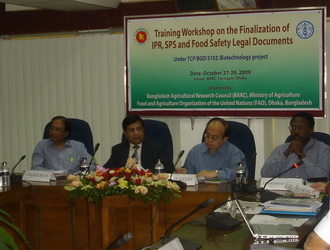 Bangladesh Cabinet Secretary Abdul Aziz voiced out the urgent need to consider biotechnology ventures to alleviate the present food crisis. The Cabinet Secretary was the chief guest during the three-day training workshop on the finalization of Intellectual Property Rights (IPR), Plant Variety Protection (PVP) Sanitary and Phytosanitary Measures and Food Safety Legal Documents under the Food and Agriculture Organization- administered project Assistance in the formulation of enabling regulatory measures for research and sustainable application of biotechnology at the Bangladesh Agricultural Research Council (BARC) in Dhaka. The meeting was attended by around 120 senior officials from various stakeholder organizations.
Agriculture Secretary CQK Mustaq Ahmed said that Bangladesh needs to formulate and promulgate the relevant legislations and legal documents to harness the most from the benefits of biotechnology. Mr. El Zein El Muzamil, FAO Representative in Bangladesh, expressed and committed support to help finalize the legal documents. Dr. Wais Kabir, Executive Chairman of Bangladesh BARC, presided over the meeting and assured his part in making the biotech legal documents come into being.
Contact Dr. K.M. Nasiruddin, national coordinator of the Bangladesh Biotechnology Information Center at k.nasiruddin@isaaa.org for additional information about the workshop.
BAYER AND SCIVAX SIGN RESEARCH COOPERATION
Bayer CropScience announced that it has entered into a research cooperation with Japan-based biotech company Scivax Corporation to develop high-yielding plants that can tolerate abiotic stress conditions. The companies will focus first on cotton. Under the terms of the agreement, Bayer will sponsor and support Scivax's Research & Development (R&D) activities for the next three years. In turn, Scivax grants Bayer an option to obtain a worldwide, exclusive license to their patent portfolio for use in crops.
Scivax has been developing technologies for enhanced yield since 2005 under collaboration with Meijo University and Nagoya University.
View the press release at http://www.press.bayercropscience.com/bcsweb/cropprotection.nsf/id/EN_20091029?open&l=EN&ccm=500020
NEGRENSES OPEN TO BOTH ORGANIC AGRICULTURE AND BIOTECHNOLOGY
"Teamwork for organic agriculture and biotechnology must be tapped to achieve the quest for higher agricultural production and sustainable environment," said Tanjay City Agriculturist Boy Diputado during the ASFARNET Philippines-led Agricultural Forum: Understanding Agri-biotechnology and its Benefits, held last October 22 at Dumaguete City, Negros Oriental, Philippines. He added that based on his understanding, both agricultural practices could provide higher yield, and safer and healthier food for both the public and the environment. He believes that both interventions can positively impact farmers and consumers, as well as enrich biodiversity in the island.
Similarly, Provincial Corn Coordinator of Negros Oriental Medardo Villalon said that all agricultural opportunities must be provided to the farmers in the island in order for them to meet diverse market potentials. He added that a careful combination of organic agriculture and biotechnology will be perfect for subsistence farmers and market-oriented farmers in Negros' agricultural industry.
Meanwhile, Chemin Teves, a farmer from the island, saw biotechnology as an opportunity to increase farming income and reduce agricultural inputs. Based on his 3-year experience in planting Bt corn, he was able to increase yield by as much as 6 tons compared with conventional corn. Currently, he is also trying the herbicide tolerant corn and is optimistic on saving his capital and getting more profit from using these biotech seeds.
ASFARNET Philippines, a coalition of farmer-leaders in the country, is continuously undertaking a sustained farmer-driven education campaign to enhance biotechnology understanding, sharing and exchange of farmer experiences in biotech adoption.
For more information on biotechnology updates in the Philippines, visit http://www.bic.searca.org or emailbic@agri.searca.org.
Europe
KEYGENE COMPLETES PHYSICAL MAP OF THE TOMATO GENOME
Netherlands-based biotech company Keygene announced that it has completed and delivered to the International SOL Consortium a sequence-based physical map of the 950 Mb tomato genome. Keygene worked with scientists at the Centre for BioSystems Genomics (CBSG), the Dutch National Center for plant genomics research, and constructed the physical map using its proprietary whole genome profiling technology.
The International SOL Consortium is producing a high-coverage shotgun sequence of the tomato genome using the GS FLX Titanium (Roche) and SOLiD (Life Technologies) sequencing platforms and Keygene's map will be used as a scaffold for developing the draft genome sequence. A superior draft sequence of the tomato genome is expected to be produced by the end of this year.
For more information, read http://www.keygene.com/keygene/pdf/PR%20231009.pdf
Research
FATE OF RECOMBINANT DNA AND BT PROTEIN AFTER INGESTION AND DISPERSAL OF WILD BOARS AND DEER
With funding from the German Federal Agency for Nature Conservation, researchers from the Technical University of Munich (TUM) examined in detail how fallow deer (Dama dama) and wild boars (Sus scrofa) metabolize genetically modified corn. Specifically, the scientists wanted to find out if transgenic residues accumulate in boar and deer meat and if the animals spread GM corn via their feces. The answer in each case is no, according to the TUM scientists.
Heinrich Mayer and colleagues fed fallow deer living in outdoor enclosures and wild boars kept in pens genetically modified corn chaff and grain corn for several weeks in a row. To study the degradability of ingested DNA, they used polymerase chain reaction (PCR) assays to detect fragments of GM-corn specific genes. ELISA was also used to detect the Cry1Ab protein.
Samples from the digestive tract, internal organs, blood and muscles of fallow deer all tested negative for the presence of transgenic components. "In conclusion, after uptake of GM corn, neither cry1Ab-specific gene fragments nor Cry1Ab protein were detected in the GI tract of fallow deer, indicating complete digestion of the GM corn," Mayer and colleagues wrote in the paper published by the European Journal of Wildlife Research. The researchers found small fragments of GM corn genes in the digestive tract of GM-fed wild boars. However, outside of the gastrointestinal tract the scientists found no trace whatsoever.
Mayer and his team also collected samples of feces for intact kernels capable of germination. They reported that for wild boars a mere 0.015 percent of the conventional and 0.009 percent of the GM corn kernels were excreted intact. The fallow deer were even tougher on the corn: Not a single intact and thus germinable corn could be found in their feces.
The papers published by the European Journal of Wildlife Research and Mammalian Biology are available for download at http://dx.doi.org/10.1007/s10344-007-0104-4 and http://dx.doi.org/10.1016/j.mambio.2008.07.002 respectively.
VIRUS-RESISTANT GM SQUASH MORE VULNERABLE TO BACTERIAL WILT ATTACK, STUDY FINDS
Squash plants genetically modified to resist viral diseases become more vulnerable to a fatal bacterial infection, researchers at the Pennsylvania State University found. In a three-year study, Andrew Stephenson and colleagues examined the effects of the transgene on fitness, on herbivory by cucumber beetles, on the incidence of mosaic viruses, and on the incidence of bacterial wilt disease.
The researchers found that the fitness advantage enjoyed by virus-resistant plants comes at a price. "Plants that do not have the virus-resistant transgene get the viral disease," explained Stephenson, whose team's work is funded by the National Science Foundation. "However, since cucumber beetles prefer to feed on healthy plants rather than viral infected plants, the beetles become increasingly concentrated on the healthy -mostly transgenic - plants."
Results showed that the prevalence of bacterial wilt disease was significantly greater on transgenic plants than on non-transgenic plants. "When the cucumber beetles start to feed on infected plants they pick up the bacteria through their digestive system," explained Miruna Sasu, co-author of the study published this week in PNAS. "This feeding creates open wounds on the leaves and when the bugs' feces falls on these open wounds, the bacteria find their way into the plumbing of the plant."
The paper is available at http://dx.doi.org/10.1073/pnas.0905106106 For more information, read http://www.environment.psu.edu/news/2009_news/oct_2009/modified_crops.asp
PLANT PROTECTION: A PHYLOGENETIC TREE OF NEMATODES
Researchers at the Wageningen University in the Netherlands, working with scientists from the Dutch Plant Protection Service, have published the largest nematode phylogenetic tree to date. The researchers used a specific segment of the ribosomal DNA that allowed them to distinguish between most nematode species.
Nematodes are the world's most numerous groups of animals with two to 20 million individuals, normally smaller than one millimeter, per square meter of soil. Some nematodes are beneficial, for instance members of the Steinernematidae and Heterorhabditidae families are being used to control insect pests. However, most useful species share a strong resemblance to pathogenic species. This makes finding out which nematodes are present in a soil of a given area an extremely time-consuming and a specialist task. Accurate identification is vital to developing a successful management program against plant parasitic nematodes.
"[The phylogenetic tree] contains over 1,200 species and is entirely based on the analysis of DNA sequence data. It is relatively straightforward - and in fact we've shown it already - to define species-specific DNA barcodes on the basis of this data set that allows for the detection of nematodes in soil with an unprecedented accuracy," the scientists wrote in the paper published by Nematology.
Download the paper at http://dx.doi.org/10.1163/156854109X456862 For more information, read http://www.wur.nl/UK/newsagenda/news/On_the_origin_of_nematodes__A_phylogenetic_tree_of__the_
worlds_most_numerous_group_of_animals.htm
Announcements
BRAZILIAN AGENCIES CALL FOR BIOTECH PROJECT PROPOSALS
The Brazilian Ministry of Science and Technology (MCT) the National Council for Scientific and Technological Development (CNPq) are seeking proposals for biotechnology-related projects, specifically on topics such as metagenomic profiling, global gene expression analysis, proteomics and metabolomics, "third generation" biofuels, animal and plant vaccine development, RNA interference and intellectual property rights in biotechnology. Approved projects will be financed with funds totaling BRL 500 thousand (USD 265 thousand).
More information is available at http://carloschagas.cnpq.br/ and http://www.ufma.br/noticias/noticias.php?cod=6390
GENOTYPING SUPPORT SERVICE: 3RD CALL FOR PROPOSALS
Generation Challenge Programme's (GCP's) Genotyping Support Service (GSS) has recently launched its third call for proposals. The GSS aims to help spread the benefits of marker technology in the developing world through technology access, capacity-building and sustainability and spread. The call is being launched in conjunction with a call from the Global Crop Diversity Trust, which focuses on supporting the evaluation of crop genetic resources.
Eligible applicant organizations will be national agricultural research systems, academia, civil society organizations or private companies, located in developing countries and active in plant breeding and/or germplasm conservation for the main food crops. Applicants should be willing to incorporate the use of molecular maker technologies with a long-term perspective. The deadline for applications is on December 15, 2009.
Visit http://www.generationcp.org/sp5/?da=09166016 for more information.
Document Reminders
BT COTTON IN INDIA – A STATUS REPORT
The Asia-Pacific Association of Agricultural Institutions (APCoAB), a program on Asia-Pacific Association of Agricultural Research Institutions (APAARI), has released the second edition of its report on Bt cotton in India. It provides up to date information on development, production and economic effects of Bt cotton, and highlights contemporary issues related to the technology and the impact of its adoption in India. The report is available at www.apcoab.org and www.apaari.org. Get a printed copy of this publication by contacting j.karihaloo@cgiar.org .
(c) 2026. ISAAA.